
TV is not dead. It's now connected. And 25% of it is fraudulent.
Pixalate measured a quarter of the open programmatic connected TV market as invalid traffic in Q1 2026. DoubleVerify caught a bot farm this month selling fake World Cup inventory at USD 50 CPMs. And the money keeps moving in, because the audience the industry wrote off a decade ago turned out to be sitting exactly where it always was.

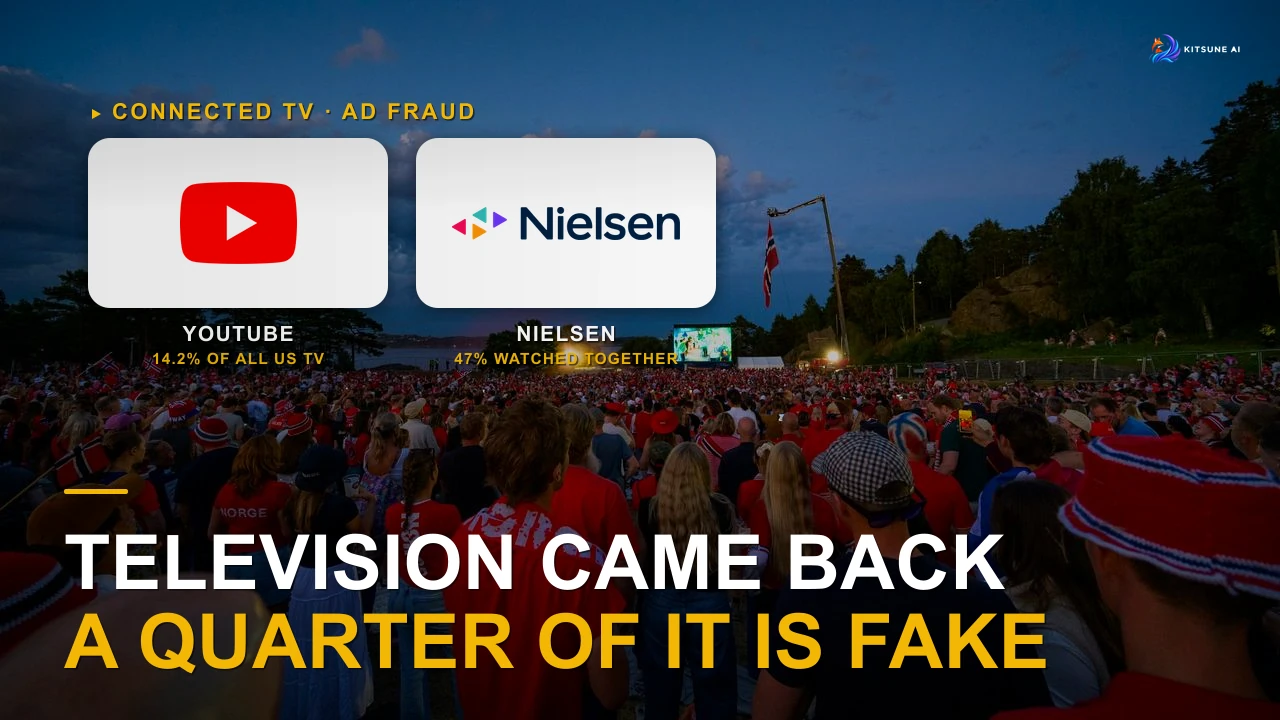
- DoubleVerify found a CTV scheme inside premium live sport on 3 September. Every fake session ended at the 90 minute mark, including the matches that went to extra time.
- Pixalate puts 25% of global open programmatic CTV traffic in Q1 2026 in the invalid column. 51Degrees found 4.92% of inventory sold as CTV was not CTV, against 0.18% mislabelled the other way.
- The reason it only runs one way is the price. A CTV impression clears around USD 25. A mobile in-app display impression clears USD 2.50.
- Television was supposed to be dead. In July 2026 YouTube hit a record 14.2% of all US TV viewing and streaming crossed 49% of total TV.
- Nielsen measures 47% of linear and connected TV as watched by more than one person at once. In 2017 linear was 48% and streaming 34%. That gap has closed to nothing.
Some time in the last three months a bot farm sat down to watch the World Cup.
DoubleVerify published what it found on 3 September. A scheme they called KickBot had been manufacturing connected TV inventory inside premium live sport, the most expensive video an advertiser can buy, going for USD 50 CPMs and up. Over three months dozens of brands paid those prices for traffic that was entirely invented. A global spirits brand. A national political campaign. A global airline. A fast food chain.
It got caught on a detail that is almost funny. Every session ended at exactly the 90 minute mark. The people who built it knew a football match lasts ninety minutes. They did not know about stoppage time, extra time or penalties. So on the nights the games ran long, thousands of televisions that did not exist all switched off together while the real ones stayed on.
I bought television for years on cost per rating point, running Nestle Pakistan's media budget. We argued about the ratings constantly. Every buyer did. What nobody ever had to ask was whether the commercial had physically played on a television set. That question did not exist. It exists now, and for a quarter of the open market the answer is no.
The industry buried television, then quietly rebuilt it
For fifteen years the settled view was that the television set was finished. Young people would watch alone on phones. The living room was a nostalgia product.
Then look at what Nielsen published on 10 September. In July 2026 streaming reached 49.0% of all television use in the United States. YouTube alone took a record 14.2%, five full share points ahead of the next distributor in the country. Broadcast was 19.5%. Cable was 18.7%.
YouTube. The company built for a phone in a pocket. Its chief executive Neal Mohan has already confirmed that the television set is now YouTube's primary device in the US, running over a billion hours of viewing on TV every day. In Britain, Ofcom found YouTube on the TV set went from 9 minutes a day in 2022 to 19 minutes in 2025.
Television came back with the word connected in front of it, doing exactly what it always did.
The money has already worked this out. US connected TV upfront commitments this year reached USD 17.73bn against primetime linear's USD 16.98bn, the first time streaming has beaten primetime in the upfront. And 54% of advertisers raising CTV budgets are taking that money straight out of linear TV. The same budget, walking across the hall.
More than one person is watching, which is the whole point of television
Here is the number the industry keeps under the table because it does not fit the decade of strategy decks that came before it.
Nielsen measures 47% of linear and connected TV as consumed by more than one person at a time. That is a count of people on the panel, watching the same programme at the same moment. And the convergence is the real finding: in 2017 a Roku study put linear co-viewing at 48% and streaming at 34%. Today Nielsen reports virtually no difference between the two.
Streaming turned into television.
Outside the US the effect is stronger. WPP Media, The Trade Desk and Ormax measured Indian connected TV this year and found one impression reaches an average of 2.5 people, with more than 80% of viewing shared.
Social video is a different behaviour, which is why its size settles nothing here. Social is one person and one screen. Nobody calls the family in to watch a feed. Television is where people watch together, it still is, and the industry declared it dead anyway.
The proof that an ad played on a television is two lines of text the seller writes
Most connected TV advertising is delivered by server-side ad insertion. The ad is stitched into the video stream on a server before it reaches the set, which is what makes streaming feel like broadcast instead of a web page with a spinning wheel.
The consequence is that no code ever runs on the television. In display advertising a tag fires in the browser and reports back. In CTV there is nothing on the device to ask.
So what does the buyer get as evidence? Two HTTP headers. HUMAN Security's teardown of ICEBUCKET, the first large spoofing case, put it plainly: the information available to advertisers in these environments is often limited to the device user agent and the IP address, and falsifying that data is relatively simple. There is no signature on those headers and nothing to check them against. The seller writes them.
The scale that makes possible is hard to hold in your head. In July, HUMAN disrupted an operation it named NewsJunkie, running fake local news channels. One app claiming to be a local news channel for Jacksonville, Florida produced 42.2 billion bid requests in two months. HUMAN notes the same app had 185 reviews in the app store. Roughly the ad volume of WebMD, from one city's local news, watched by nobody.
A USD 2.50 impression wearing a USD 25 label
This happens because of the gap between two prices.
Current US benchmarks put standard connected TV around a USD 25 median CPM, mobile video at USD 12 and mobile in-app display at USD 2.50. Take an impression worth two and a half dollars, write television in the device field, and it sells for twenty five.
Which is exactly the shape of what 51Degrees found. They read 11.03mn bid requests over six days in May. 4.92% of what was sold as CTV was not CTV. And the reverse error, real television wrongly labelled as something cheaper, was 0.18%. Twenty seven to one, all of it running uphill towards the higher price. Clerical mistakes do not have a commercial preference. Their chief executive James Rosewell went further in the trade press: anyone misrepresenting non-CTV as CTV is likely doing so fraudulently.
I will be straight about the weak spot in that study, because a reader will find it. 51Degrees sells device detection, and their taxonomy treats a streaming stick as something other than a television, so part of that 4.92% is a definitional argument rather than a theft. Their USD 2bn global figure is their own extrapolation from six days. None of which touches the 27 to 1 ratio, and that ratio is the finding.
Pixalate, measuring separately across 103 billion impressions, puts 25% of global open programmatic CTV traffic in the invalid column for Q1 2026. DoubleVerify counted 140% more distinct CTV fraud schemes in Q1 2026 than Q1 2025, and measured fraud at under 1% on protected campaigns against nearly 9% on unprotected ones. That second pair of numbers is the entire argument for verification, and it is also the reason nobody can claim this is unsolvable.
Nobody in the business can agree what a television is
Ask two credible sources how big US connected TV was this year. The IAB says USD 29.3bn. EMARKETER says USD 36.95bn. The difference is almost entirely YouTube watched on a television set, which the IAB files under social video and EMARKETER files under CTV.
Same screen, same family, same evening, seven billion dollars apart depending on whose spreadsheet you open.
The industry knows. The IAB put a standard called Redefining Media Types out for public comment through August precisely because its own vocabulary had stopped meaning anything. And on 31 August Nielsen shipped new universe estimates, rebuilding the base that every share figure above is calculated against.
This is a market measuring an audience it cannot define, in units it cannot verify, against a denominator it changed last month.
Connected TV tells a buyer less than YouTube does
The part that should end the argument about which channel is the sketchy one.
On CTV an advertiser typically receives an app name and, with luck, a genre label. Show level and programme level data is almost entirely withheld. YouTube, the platform media buyers have spent fifteen years calling unsafe, hands over the channel title and the exact video an ad ran against for a large share of impressions.
Sellers say this openly. An NBCUniversal spokesperson told AdExchanger that generally, their deal IDs are at the aggregate level. At a Digiday summit, agency buyers speaking without attribution put it harder: we are being blinded, the publishers control all the inventory, and the middlemen control all the ability for us to check that inventory.
Something is moving. FreeWheel began rolling out free show level reporting in July 2026 with A+E, NBCUniversal, Paramount, Warner Bros. Discovery and others signed up. It is optional for publishers, and it arrived about eighteen months after buyers started saying this in public.
The buy side knows, and keeps writing the cheque
This is the part I find genuinely interesting, and it is where the story stops being about fraud.
The IAB asked buyers how much confidence they have in the inventory they purchase. 43% reported little or no confidence in even the most trusted CTV buying methods, meaning direct insertion orders and programmatic guaranteed. For open exchange it runs past two thirds. Fraud was the leading concern.
And spending went up anyway.
The ANA said the quiet part in its own benchmark. With connected TV now around 40% of programmatic spend, marketers accepted measurement gaps in exchange for premium content and trusted environments.
That is the confession, in the buy side's own trade body's words. They know they cannot verify it. They are paying for it regardless. Which tells you the audience being bought is real enough to be worth the risk, and everybody in the transaction has decided the audience is genuinely there.
They are right about that. Where they are wrong is in continuing to buy television through plumbing designed for banner ads. The whole apparatus of programmatic was built for a web page, where a tag could fire and report back, and the real prize in that system was always the television budget. The budget arrived. The verification did not come with it.
One last thing worth knowing before anyone treats the verification firms as the heroes of this story. In March 2025 Senator Mark Warner referred IAS, DoubleVerify and HUMAN Security to the FTC and the Justice Department, asking whether their claims about blocking bot traffic amount to more than marketing puffery. Most of the research above comes from those three companies. Take the finding and keep the question.
Television came back. Forty seven percent of it is watched by more than one person, the biggest platform on it was built for telephones, and a quarter of the open market for it is invalid traffic sold at a ten times premium over what the same impression is worth anywhere else. The audience did the honest part. The industry selling access to it has not caught up.
An early obituary for The Trade Desk: how big tech broke media
By 2015 agencies had already picked them as the independent desk. 21 months after the USD 70bn high, ChatGPT ads went th
Read article
The math isn't mathing for global sports streams. NBA talks with Youtube called out as a fire sale.
Tech blogs are calling the NBA talks with YouTube a streaming revolution. It is a bankruptcy fire sale. Cable subsidized
Read article
Marketers think they run the company. And yet, they've been booted off all FTSE100 boards.
I left marketing. Not because I stopped being good at it, because I could not see a future in it. Yesterday a study coun
Read article