
Netflix’s ad push is falling short of its forecast
Netflix’s advertising forecast has slipped as subscription growth slows across a maturing market. Amazon and Apple can attach streaming to customer relationships that already span retail, advertising, devices and services. That changes the economics of keeping a viewer and finding the next customer.

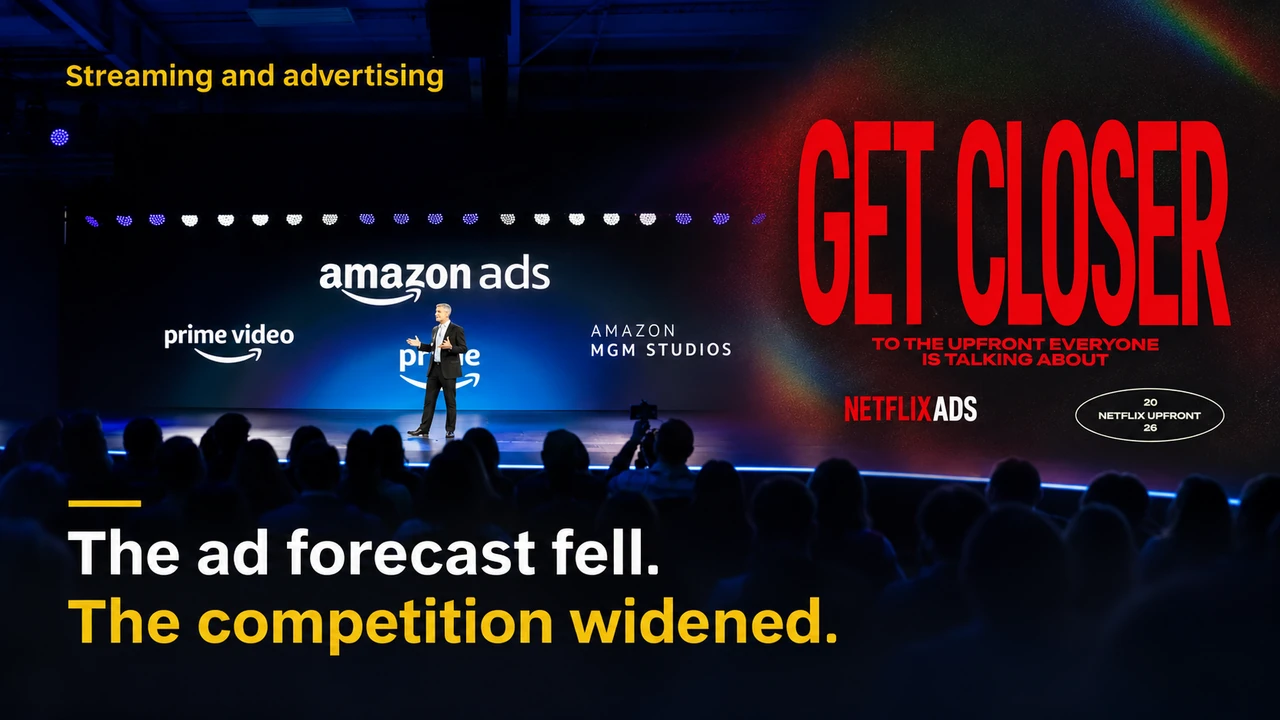
- Netflix lowered its 2026 advertising forecast by $300 million after some ad-product capabilities took longer to roll out, while subscription revenue growth exceeded expectations. Netflix’s Q3 2026 shareholder letter
- Global online-video subscription growth is forecast to slow to 5.6% in 2026. UK household take-up has been relatively steady, and US consumers report frequent streaming cancellations. Omdia’s online-video forecast, Ofcom’s Media Nations 2026, Deloitte’s Digital Media Monitor
- Amazon connects Prime Video advertising with first-party signals and purchase analysis. Apple places Apple TV inside a lower-priced bundle of services. Amazon’s Prime Video advertising guide, Amazon Marketing Cloud’s Prime Video signals, Apple One
- Netflix has substantial ad reach and commitments. Its forecast cut shows the work still required to make that audience repeatable revenue for an independent streamer. Netflix’s 2026 upfront announcement, Netflix’s upfront close
Netflix has the audience, but its own forecast cut the 2026 ad-revenue outlook by $300 million because some ad-product capabilities took longer to roll out. Reach only becomes repeat advertiser spend when agencies can plan, buy and measure campaigns reliably. Clips may bring more discovery into the app; Netflix still needs to make the ad product work at scale. Overall OTT market globally has started to stagnate. The biggest players at the end of this will likely be the ones with multiple business backing the integrated OTT offering, like Apple TV and Amazon Prime TV.
Streaming growth is slowing as households manage a crowded bill
Netflix’s October 20 shareholder letter lowered its 2026 ad-revenue forecast from approximately $3 billion to about $2.7 billion, citing the slower rollout of some ad-product capabilities. The same letter said subscription revenue growth outperformed expectations and maintained a full-year revenue outlook of $51.1 billion, up 13%. The forecast change is an advertising execution delay inside a growing business. Netflix’s Q3 2026 shareholder letter
The pressure around that execution comes as subscription growth eases. Omdia counted 2.24 billion global online-video subscriptions at the end of 2025, up 17.6% year over year, and forecasts 5.6% growth in 2026. The market is still expanding, while each new subscriber is becoming harder to add at the pace platforms saw during the previous year. Omdia’s online-video forecast
In the UK, Ofcom reports that household take-up of subscription video services has remained relatively constant over recent years. In the US, Deloitte’s fall 2026 survey found that 43% of consumers had cancelled a paid streaming service in the preceding six months. The average subscribing household reported $76 in monthly SVOD spending. These snapshots point to a practical constraint: a streamer must keep earning its place in a household’s recurring budget while competing for attention with services the household already has. Ofcom’s Media Nations 2026, Deloitte’s Digital Media Monitor
That makes retention and distribution part of the product’s economics. A standalone service depends heavily on viewers renewing that particular subscription. A company with other customer relationships can put streaming in front of people through more than one route, and can connect the service to a broader set of reasons to stay.
Amazon connects Prime Video ads to retail and purchase signals
Amazon’s business gives Prime Video an unusually direct link between viewing and customer activity. Its 2025 filing reported $68.6 billion in advertising-services revenue and $49.6 billion in subscription-services revenue. Amazon sells Prime Video advertising through tools that use its first-party signals, and its Marketing Cloud allows advertisers to combine Prime Video viewing signals with their own datasets to study customer behavior and purchase patterns. Amazon’s 2025 Form 10-K, Amazon’s Prime Video advertising guide, Amazon Marketing Cloud’s Prime Video signals
For an advertiser, that connection can make Prime Video easier to evaluate alongside campaigns that already use Amazon’s advertising tools. The platform can place video exposure within a wider view of audience activity, then help the buyer study what happened after exposure. That is a useful commercial link between an ad impression and a purchase question. Amazon’s filing groups Prime membership fees within subscription services, so the published totals do not assign Prime Video its own revenue or profit. Amazon’s 2025 Form 10-K
The retail connection also supports the customer relationship around Prime. Video is one reason a member may value the service, while shopping, delivery and other Prime benefits create reasons to keep the membership active. The public evidence supports a business with several customer revenue streams and advertising tools tied to retail signals. It does not quantify how much those businesses fund video production. The advantage visible to a customer is the combined offer and the number of ways Amazon can keep serving that customer.
Apple makes TV part of a wider services bundle
Apple’s integration works through services and devices. Its 2025 filing reported $109.2 billion in Services revenue. Apple One bundles Apple TV with services including Music, Arcade and iCloud+ at a lower combined monthly price. Apple also promotes three free months of Apple TV with the purchase of a new iPhone, iPad or Mac. Apple’s 2025 Form 10-K, Apple One
A bundle changes the renewal calculation for a household that already values several Apple services. The customer can assess one combined package, while Apple can introduce TV through a subscription bundle or a device purchase. Each route connects entertainment to an existing customer relationship. Apple reports Services revenue across a broad category and does not disclose Apple TV’s standalone revenue or margin, so the evidence supports integration and distribution rather than a claim about direct production subsidy. Apple’s 2025 Form 10-K
Amazon and Apple therefore bring different commercial mechanisms to streaming. Amazon links video advertising to retail signals and purchase analysis. Apple bundles TV with services and promotes it through its devices. Both can reach customers through businesses already present in their lives. Those relationships can help with discovery, retention and selling other services, even as each company keeps the economics of its video offering inside broader reporting categories.
Netflix’s audience has to carry more of the business on its own
Netflix has made real progress with advertising. In May it said its ads plan reached more than 250 million monthly active viewers. The company defines that measure by counting members who watched at least one minute of ads in a month and multiplying by its estimated average household size. In August, Netflix said it nearly doubled its US upfront ad commitments for 2026 and announced its first Media Rating Council accreditation for processing and reporting US in-stream video impressions across connected TV, mobile apps and desktop web. Netflix’s 2026 upfront announcement, Netflix’s upfront close
Those signals show an ad business attracting buyers and expanding its audience. The October forecast still points to ad-revenue growth, while the $300 million reduction shows that rolling out the tools takes longer than Netflix planned. The company has added standardized conversion-event onboarding and single-publisher attribution in Yahoo DSP. It said comparable reach, frequency and attribution measurement in The Trade Desk DSP was still coming. Agencies need those planning, buying and reporting steps to fit the systems they already use before broad reach reliably turns into repeat campaigns. Netflix’s October Ads Suite update, Netflix’s Q3 2026 shareholder letter
That is Netflix’s execution gap: its audience and advertiser interest must produce a dependable ad product while the streaming subscription competes for a household budget that is growing more slowly. Clips may help viewers discover more titles, and better ad tools can create another source of revenue from the audience Netflix already has. Each still requires product execution inside Netflix’s own service and buying relationships.
Amazon connects streaming to retail signals advertisers can study. Apple can package TV with services its customers already use. Both have several reasons to keep a customer relationship active. Netflix’s scale gives it a strong starting position, but the forecast cut shows the cost of building those commercial connections inside a standalone entertainment business. As subscription growth slows, the integrated streamers backed by several businesses are better positioned to keep customers and earn from the relationships they already have.

OTT in Pakistan is dying, a slow and loud death
The audience numbers are disappointing, its nature is rented and a new entrant threatens disruption with more of the sam
Read article
How YouTube makes money in Pakistan, and who gets paid
With ARY Plus launch, the biggest content category on Youtube is under pressure. Cricket feeds from Pakistan travel thro
Read article
Ligue 1's app lasted 1 season, and its back to TV rights
Ligue 1+ is in its second season on air. The LFP is already sounding out Canal+, Amazon, Apple, Netflix and Paramount fo
Read article
The math isn't mathing for global sports streams. NBA talks with Youtube called out as a fire sale.
Tech blogs are calling the NBA talks with YouTube a streaming revolution. It is a bankruptcy fire sale. Cable subsidized
Read article