
Chinese AI companies will take the entire sovereign AI cake
Two days ago in Shanghai, Huawei's Eric Xu said he cannot sell Ascend abroad because he cannot even feed China. Read that as a schedule. China has already won open source, it is selling frontier-class output at a fiftieth of Anthropic's price, and Nvidia has booked more than USD 30bn of sovereign AI in one year. Every country that wants its own AI has to ask Washington first. China is building the shop where you do not have to.

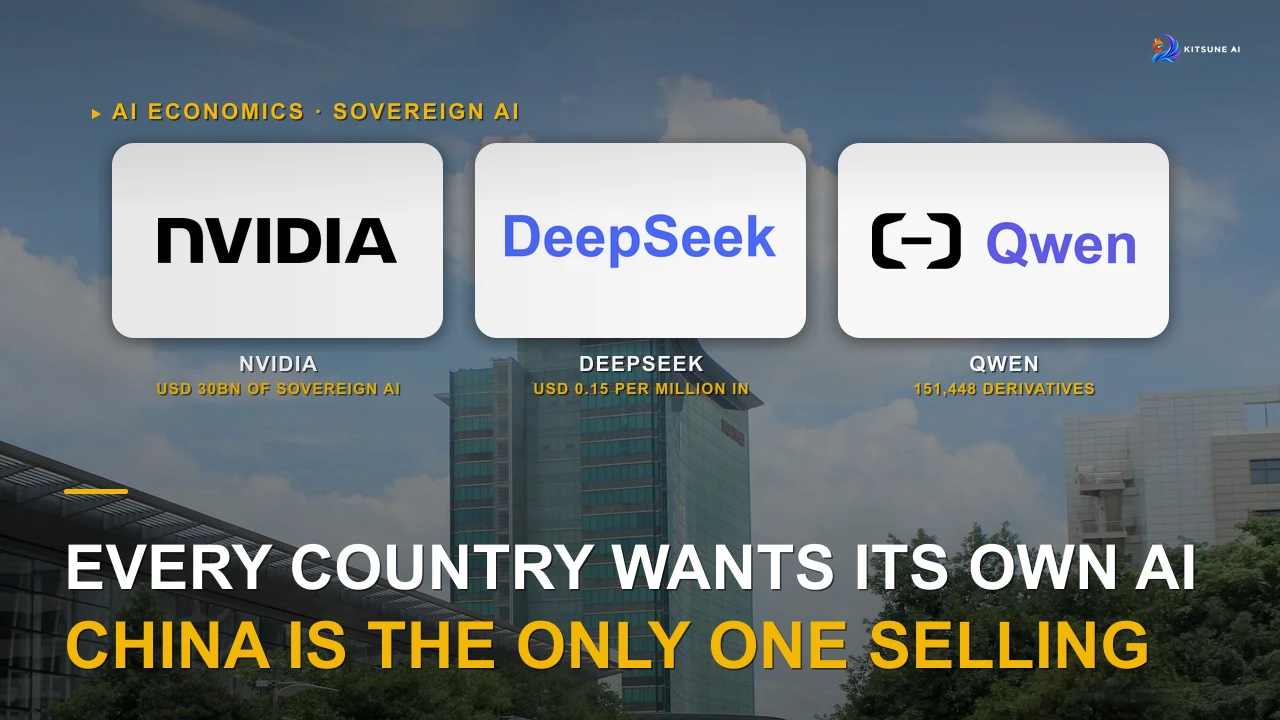
- Chinese labs took "the plurality or 41% of downloads" on Hugging Face in the year to March 2026. Qwen alone carries 151,448 derivative repositories, 2.6x Meta's entire open-source footprint.
- Zhipu's GLM-5.3-Flash sells output at USD 0.50 per million tokens. Claude Opus 5 is USD 25 and Fable 5.1 is USD 50.
- Huawei spent CNY 192.3bn on R&D in 2025 with 114,000 R&D staff, 53.7% of its people, and CNY 1.382tn over the decade. CXMT raised RMB 57.9bn on the STAR Market in July and closed its first day up 466%, the most valuable company listed in China.
- G42 and Humain each got 35,000 Blackwell-class chips in November 2025 after G42 severed its ties with Huawei and Humain pledged never to buy it. That is what American compute costs on top of the invoice.
- On 16 July, 29 countries signed the World AI Cooperation Organization into being in Shanghai. Pakistan, Malaysia, Indonesia, Kazakhstan, Brazil and South Africa are founding members.
On 17 September, on a stage at Huawei Connect in Shanghai, Eric Xu was asked whether Huawei would sell its Ascend SuperPoDs to the rest of the world. He said no. Huawei cannot make enough of them to satisfy China, so there is no plan for a full international rollout. He said Chinese supply should catch up with Chinese demand around 2030. In the same session he said Ascend has already overtaken Nvidia inside China, and moved the Ascend 960 forward to 2027.
Every Western write-up read that as a limit. It is a queue. A company that cannot serve its home market is not a company with no customers.
China already won open source, and it was not close
Hugging Face publishes the numbers itself. In its spring 2026 review, dated 17 March: "In the past year, Chinese models quickly accounted for the plurality or 41% of downloads." China passed the United States on monthly downloads and on cumulative downloads.
Downloads are the shallow measure. The deep one is what people build on top, because that is where a standard gets set. Hugging Face's summer 2026 count puts Qwen derivatives at 151,448 repositories, 2.6 times Meta's whole open-source footprint and 4.7 times the Llama repositories, growing by 180 to 210 new repos a day. On local inference Qwen runs 39.6mn downloads a month against Llama's 7.5mn.
Clément Delangue, who runs Hugging Face and can see the traffic, put the rest of it plainly to CNBC: "They're clearly dominating on open models right now, and I wouldn't be surprised if they start dominating at the frontier either by the end of this year or next year at the rate of progress."
GLM-5.3-Flash charges USD 0.50 where Anthropic charges USD 25
Zhipu shipped GLM-5.3-Flash on 26 August, 320bn parameters with 18bn active, natively multimodal, a 1mn token context window. It costs USD 0.15 per million tokens in and USD 0.50 out. The FlashX variant runs at 200 tokens a second.
Put the card up next to the American one. Claude Opus 5 is USD 5 and USD 25. Sonnet 5 is USD 2 and USD 10. Haiku 4.5, the cheapest thing Anthropic sells, is USD 1 and USD 5. GPT-5.5 is USD 5 and USD 30. DeepSeek's flash tier is USD 0.30 and USD 1.20 at peak hours and half that off peak. Qwen3.8-Flash is USD 0.15 and USD 0.47.
Fifty times on output is past the point where procurement helps. When I was running Nestle Pakistan's media and digital budget, a 10% gap started a renegotiation and a 30% gap started a pitch. Nobody in procurement has a playbook for 50x, because a gap that size does not come from margin. It comes from a seller with a different cost base and a different reason for being in the room. George Chen of the Asia Group gave the reason to Fortune: ["For the money [a Chinese AI company would] spend on an Nvidia chip, they can buy 10 local chips from Huawei or other local chipmakers."](https://fortune.com/2026/07/26/china-moonshot-deepseek-zai-kimi-challenging-us-ai-cost/)
And Z.ai says out loud what it is selling against: "Frontier intelligence should not belong to only a few people, nor be subject to withdrawal by a handful of rules at any moment." Withdrawal by a handful of rules is the product. Everything else is the demo.
Google worked this out first and got laughed at for it
The one American lab that read the market correctly is the one the industry spent three years writing off. In February 2023 Sundar Pichai told his own staff it was all hands on deck to test Bard and the press called it a code red. Google then did something unfashionable. It put its weight behind cheap and fast instead of chasing the top of a leaderboard.
Look at Google's own price list. Gemini 2.5 Flash-Lite is USD 0.10 in and USD 0.40 out. Gemini 3.1 Flash-Lite is USD 0.25 and USD 1.50. Gemini 2.5 Flash is USD 0.30 and USD 2.50. Anthropic's cheapest model costs ten times Google's cheapest on input, and Anthropic's flagship costs a hundred times more than Google's.
The volume followed the price. At I/O on 20 May 2026 Pichai said Google processes over 3.2 quadrillion tokens a month, against 480 trillion a year earlier, and that 8.5mn developers build with its models every month. By the second quarter the API was running 22bn tokens a minute and nearly 500 cloud customers had each pushed past a trillion tokens in a year. In November 2025, after Gemini 3 landed, it was OpenAI that was reported to have declared a code red.
Cheap and fast is the shape of the real market. Google found that out three years early and took the mockery. The Chinese labs are running the same play with a lower floor under it.
The embargo is what built Huawei's chip business
None of this starts with a model. It starts on 7 October 2022, when the Commerce Department cut China off from advanced AI silicon. Nvidia built the A800 and H800 to sit under the line, and on 17 October 2023 Washington moved the line and took those away too. On 9 April 2025 the H20 needed a licence and Nvidia wrote off USD 5.5bn of inventory. Licences came back in August 2025 with 15% of the China revenue payable to the US government, and the H200 followed at 25%.
Jensen Huang has been the most honest man in this story. In October 2025 he said Nvidia went from 95% market share in China to zero. By the first quarter of its FY2027, reported in May 2026, Nvidia shipped no data centre Hopper to China at all against USD 4.6bn a year before, and told investors to assume nothing from China at all.
What did the Chinese do with four years of being locked out. They spent. Huawei's 2025 annual report puts R&D at CNY 192.3bn, 21.8% of revenue, with 114,000 R&D staff making up 53.7% of the company, and CNY 1.382tn spent over ten years. The state put CNY 344bn into the third phase of the national chip fund in May 2024. And CXMT, the memory company that everybody outside China treated as a rounding error, raised RMB 57.9bn on the STAR Market on 27 July, opened at 49.50 yuan against an 8.66 yuan issue price, closed the day up 466% and became the most valuable listed company in China.
Memory was the choke point in every analysis of why Huawei could not scale. China just floated the answer to it at a USD 488bn valuation.
The chips cannot leave yet, and that is a schedule
Eric Xu was not being modest in Shanghai. Huawei is selling everything it can make, inside a market of 1.4bn people that its own government has ordered onto domestic silicon. State-funded data centre projects were told in November 2025 to use domestic chips only, with anything less than 30% built told to tear the foreign parts out.
So the export volumes are small and will stay small for a while. Xu said supply meets Chinese demand around 2030, and the Ascend 960 comes in 2027 rather than later. Anyone reading that as failure has never run a factory. It is a company with a full order book, a published roadmap, an R&D bill of CNY 192.3bn a year and a state that treats its output as strategic. The chips are late, and late is a date.
Meanwhile the software half already left, and it left for free.
The Gulf paid for its Nvidia chips by promising never to buy Huawei
Here is what American compute actually costs, and it is not on the invoice.
In November 2025, after the Saudi Crown Prince's visit to Washington, the Commerce Department cleared G42 and Humain for the equivalent of 35,000 Nvidia GB300 processors each. The conditions were explicit. G42 severed its ties with Huawei and divested from ByteDance. Humain pledged not to buy Huawei equipment. G42's Talal Al Kaissi said the quiet part for the record: "Our technology ecosystem today is firmly anchored in partnerships with U.S. and allied companies." In July 2026 the UAE was moved into the top trust tier and can now buy Blackwell without a licence per shipment.
Two of the richest states on earth, with their own money, were told what they may not buy from a third country in order to buy from the first. Call it what it is. Sovereign AI is being sold with a clause about whose equipment you are allowed to own.
Pakistan's National Telecommunication Corporation signed a three-year deal in July for Nvidia H200s, B200s and A100s serving Llama 3.1, GPT OSS 20B, Qwen3 32B and Kimi K2 to federal departments. American cards, Chinese and American models on top, nobody asked for a signature about Huawei. That is the configuration a country gets when it is too small to be worth a condition. It is also, right now, the best deal in the room.
China has already opened the shop
The size of the prize is on Nvidia's own earnings call. Sovereign AI passed USD 30bn of revenue in its FY2026 and more than tripled year on year, and CFO Colette Kress told investors why: "Every country will build and operate some parts of its AI infrastructure, just like with electricity and Internet today."
Every country. Saudi Arabia and the UAE can pay the political price for American silicon. India, Indonesia, Malaysia, Kazakhstan, Brazil, Nigeria, Vietnam and Pakistan are going to be offered the same contract with the same clause, and most of them will not want to sign it.
China has already built the counter. On 16 July 2026, 29 countries signed the World Artificial Intelligence Cooperation Organization into existence in Shanghai, headquartered in Shanghai, launched by Xi Jinping on the eve of the World AI Conference. The founding members include Pakistan, Malaysia, Indonesia, Kazakhstan, Brazil, Russia, South Africa and Senegal. It is an intergovernmental body with a building, a charter and a member list, aimed squarely at the countries that will be buying sovereign AI for the next decade.
So count what is on the shelf. Open weights that are already the default and cost nothing. Inference at a fiftieth of the American price. A domestic accelerator that has passed Nvidia in its home market and has a 2027 part already pulled forward. A memory supplier that is now the most valuable listed company in the country. And an intergovernmental club with 29 members, most of them exactly the states writing national AI budgets this year.
The only thing China has not got yet is spare chips, and Eric Xu just told everyone the date. Washington spent four years making sure nobody could buy Chinese hardware. It never occurred to anyone that China would spend those same four years building a shop.
The frontier just became a policy decision. Open models became the only foundation you can build on.
When a model ships only when a government says it can, the open-weight runt that you actually control stops being the co
Read article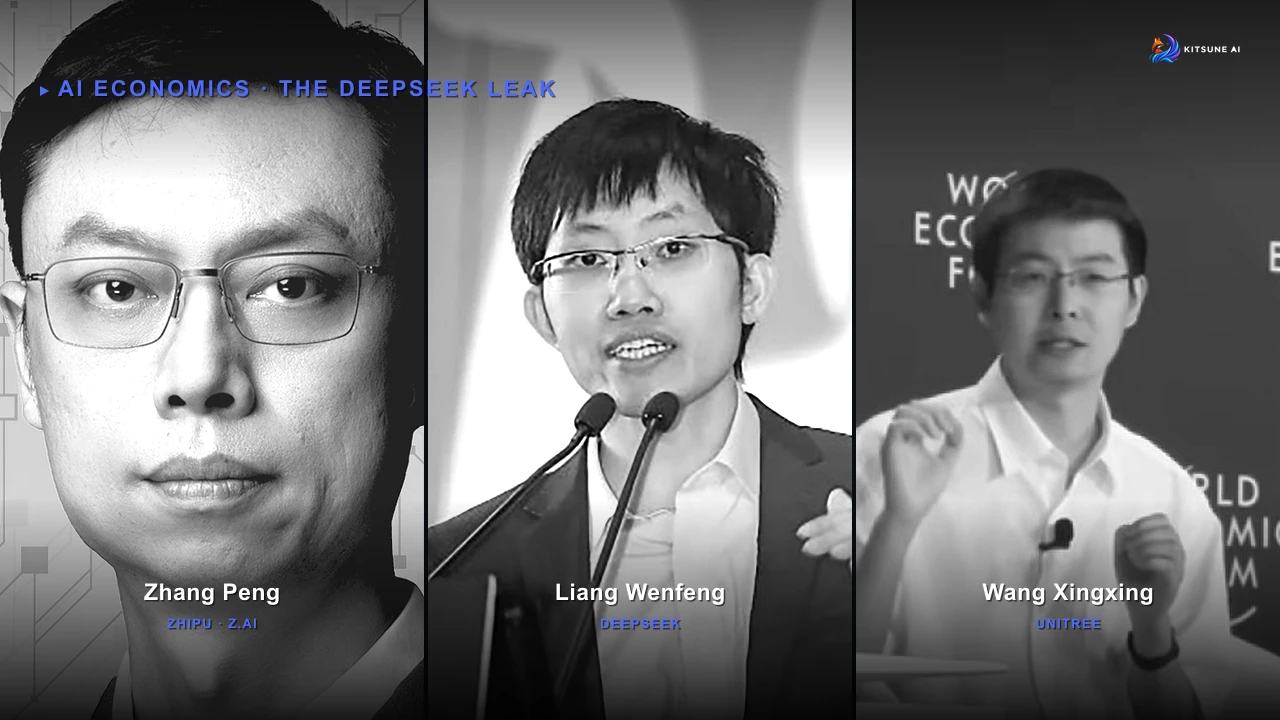
Who wins when intelligence is so cheap it might as well be free?
Intelligence gets cheaper every month, and DeepSeek's leaked shareholder tape shows why that never reverses. Selling int
Read article
Tokens are out, results are back in: AI subs hit ceiling
Ramp reported that America's biggest AI spenders cut their spend by 10%, and Sysco told investors it will reduce USD 100
Read article