
AI is not paying for itself. Its suppliers are, and they are booking it as revenue.
Microsoft has committed USD 13.0bn to OpenAI and booked USD 24.1bn of revenue from OpenAI in a single financial year. Nvidia's stake in privately held companies went from USD 3.4bn to USD 47.9bn in eighteen months, and its own 10-K says those companies buy its chips. The money is going round, and every circuit prints a bigger valuation.

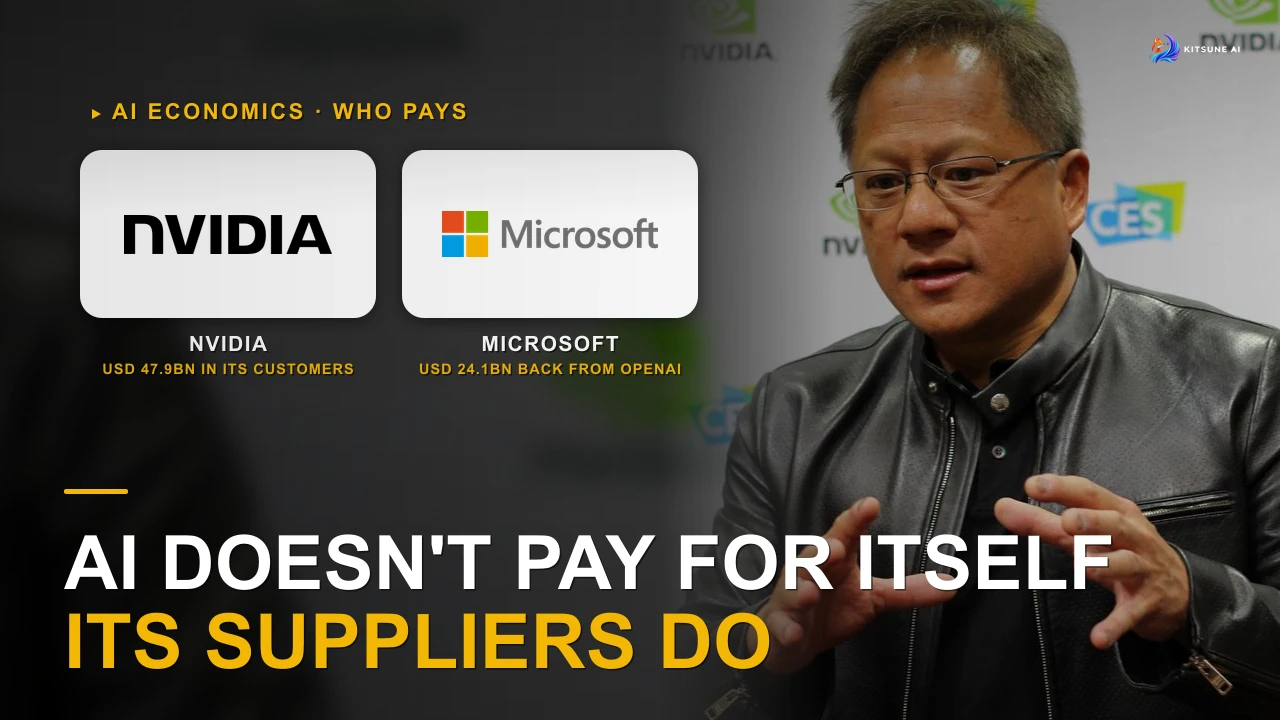
- Microsoft's FY2026 10-K discloses USD 13.0bn committed to OpenAI, USD 11.9bn funded, and USD 24.1bn of revenue recorded from OpenAI in one year, with USD 6.0bn still owed at year end.
- OpenAI holds a warrant for 160mn AMD shares at USD 0.01 each. It vests as OpenAI buys AMD chips and as AMD's share price climbs to USD 600.
- Nvidia's own 10-K: "We invested $17.5 billion in private companies and infrastructure funds... These investments include AI model makers that purchase our products."
- Nvidia's CFO Colette Kress, on an earnings call: "we know some will call this circular financing. We see it differently." In the same remarks she said the labs "are growing faster than what their balance sheets and credit profiles can support."
- OpenAI's own projection is USD 856bn of compute spend through 2030 against USD 840bn of cumulative revenue. Compute alone costs more than everything it expects to sell.
Last October, AMD gave OpenAI the right to buy 160mn of its own shares for one cent each.
That is roughly a tenth of the company, for about USD 1.6mn in total. The 8-K sets out what OpenAI has to do to earn it. The first tranche vests when AMD delivers one gigawatt of chips. Full vesting requires six gigawatts of AMD purchases. And on top of that, the final tranche only lands if AMD's share price reaches USD 600.
Read that arrangement twice. OpenAI is paid in AMD stock for buying AMD chips, and paid more if buying AMD chips pushes AMD's stock up.
All of it was filed with the SEC and announced in a press release. This is the ordinary way the industry now does business, and once you have seen the shape of it you see it everywhere.
The suppliers are buying their own customers
Nvidia holds equity in the companies that buy its chips. It says so in its annual report, in plain words:
> "We invested $17.5 billion in private companies and infrastructure funds, primarily to support early-stage startups. These investments include AI model makers that purchase our products directly or through CSPs."
Watch the balance sheet line for those holdings move. Non-marketable equity securities were USD 1.3bn in January 2024. A year later, USD 3.4bn. By January 2026, USD 22.3bn. By July 2026, USD 47.9bn.
In the first half of its current financial year Nvidia spent USD 42.4bn buying equity securities. The comparable figure a year earlier was USD 1.2bn. That is 57% of half-year operating cash flow going out to buy stakes, much of it in businesses whose purpose is to buy Nvidia hardware.
It goes further than equity. In August, Nvidia guaranteed up to USD 105bn of land, power and building lease obligations for data centre capacity on behalf of an affiliate of OpenAI. Nvidia is standing behind the rent on the buildings that will house the chips it sells.
And Nvidia buys back the other way too. Its filings describe committing to cloud service agreements with the same AI clouds that purchase its infrastructure. With CoreWeave the arrangement is explicit: a USD 6.3bn order form under which Nvidia is obliged to buy any capacity CoreWeave cannot sell, through to 2032.
Chips sold to a cloud, financed by the chipmaker, with the chipmaker as buyer of last resort for the output.
Microsoft's accounts show what the money actually does
The clearest number in this entire story sits in Microsoft's annual report, because OpenAI is a related party and the disclosure is therefore mandatory.
> "For fiscal year 2026, we recorded revenue from commercial arrangements with OpenAI, inclusive of revenue-sharing payments, of $24.1 billion, and accounts receivable from OpenAI as of June 30, 2026 was $6.0 billion. We have made total funding commitments of $13.0 billion related to our investment, of which $11.9 billion has been funded as of June 30, 2026."
Microsoft has put USD 11.9bn into OpenAI over several years. In the most recent twelve months alone it recognised USD 24.1bn of revenue from OpenAI. That is 7.3% of everything Microsoft sold last year, from one company it part owns and helped fund.
I am a buyer of this software, not an investor in any of it, and this is the sentence that matters from where I sit. When a supplier funds its customer and books the returning money as revenue, the revenue is real in the accounts and it is not evidence of anybody new wanting the product.
Nvidia's own finance chief has already answered this charge
The most useful quote on this subject comes from inside the company. Colette Kress, Nvidia's chief financial officer, on the August earnings call, discussing credit support for a frontier lab:
> "We recognize the scale of this support, and we know some will call this circular financing. We see it differently."
She is entitled to see it differently. But she said something else in the same remarks that is harder to work around. The frontier labs, she said, "are growing faster than what their balance sheets and credit profiles can support."
That is Nvidia's CFO stating that its largest customers cannot finance their own purchases. Which is precisely why Nvidia is financing them.
Jensen Huang's version, at a Goldman Sachs conference in September, is blunter: "it's not circular because we put a little bit of money in, and a lot of money comes back." He is describing the mechanism accurately and calling the result a defence.
The bills are larger than the revenue, on their own numbers
OpenAI expects to spend USD 856bn on compute through 2030 and to take USD 840bn of cumulative revenue across the same period. Compute alone costs more than everything the company expects to sell. Cash burn over those five years is put at USD 278bn, rising from USD 36bn this year to USD 350bn in 2030. It raised USD 122bn in March and is on track to have spent it by 2028.
Anthropic's position is better and the caveat is doing heavy lifting. It told investors it recorded an adjusted operating profit in the second quarter on revenue of USD 11.5bn. Its gross margins are above 80% before accounting for revenue shared with distribution partners and the cost of training its models. A model company that is profitable before the cost of making models is a company with good unit economics on last year's product.
Torsten Slok, chief economist at Apollo, put the whole system in one sentence: "The upstream margins are real, but they are paid for out of capital raised by the layer losing money."
Lucent ran this exact play, and the SEC came for it
None of this is new. In the late 1990s telecom equipment makers lent their customers the money to buy equipment, booked the sales, and watched their share prices rise on the revenue.
Lucent's own annual report for the year to September 2000 discloses commitments "to extend credit to customers up to an aggregate of approximately $6.7 billion", plus USD 1.4bn of guarantees on customer debt. By the following year it had taken USD 2.2bn of provisions for uncollectible receivables and customer financings, and one of the customers it had financed, Winstar, was in Chapter 11.
In 2004 the SEC charged Lucent over roughly USD 1.148bn of improperly recognised revenue and USD 470mn of pre-tax income. Among the transactions in the complaint was a USD 125mn software purchase by Winstar at the end of Lucent's fourth quarter. Nortel settled its own accounting fraud case in 2007.
The Richmond Fed's account of the period is short: there was massive overcapacity, and by June 2001, when Nortel announced a USD 19bn quarterly loss, everybody could see it.
The strongest case against all of this
Honesty requires the other side, and it is better than the bears admit.
Nvidia earned USD 102.7bn of operating cash flow last year and USD 74.4bn in the first half of this one. Lucent was lending while its own cash flow lagged its profits. Nvidia is doing it out of surplus, and Kress noted the frontier-lab investments "represented a small fraction of our expected free cash flow over the same period."
The demand also looks real in places that have to be audited. Microsoft's commercial remaining performance obligations stand at USD 678bn, up 84% year on year. Alphabet's went from USD 108.2bn to USD 519.5bn in twelve months. These are contracted commitments from customers, not projections.
And the fibre laid in 1999 went unused for a decade, while today the clouds report being short of capacity, with Nvidia saying even six-year-old Ampere parts are sold out.
Michael Intrator, who runs CoreWeave, calls the circularity story ridiculous and points out that Nvidia's roughly USD 300mn of equity in a company that has raised USD 25bn is not what built the business.
Here is where that case runs out. Tomasz Tunguz of Theory Ventures wrote the best defence of Nvidia against the Lucent comparison, and his own table gives the game away. Lucent's vendor financing was 24% of its revenue. Nvidia's commitments are 67% of its revenue over the last twelve months. Top-two customer concentration was 23% at Lucent. At Nvidia it is 39%.
The counterparties are stronger. The scale is nearly three times worse.
What this costs the rest of us
Nvidia now discloses, without naming it, that "one AI research and deployment company contributed a meaningful amount of our revenue by purchasing cloud services from our customers." That is a company Nvidia invested USD 30bn in and guaranteed USD 105bn of leases for, buying Nvidia chips through cloud providers Nvidia also finances and buys capacity from.
Everybody in that sentence books revenue. Everybody's valuation rises. No customer outside the arrangement has yet been asked to cover it.
They will be. The money spent on this build has to come back through prices, and the people who pay those prices are the companies buying seats, tokens and enterprise agreements. Every business running these tools is downstream of a capital structure it never agreed to and cannot see.
The AI industry has built something that works beautifully as long as the people selling to it keep funding the people buying from it. Lucent's version lasted about three years.

The AI Money Is Leaving The Frontier Lab
The biggest valuations in tech are scrambling for revenue while the real returns walk out the door, toward data nobody c
Read article
Chinese AI companies will take the entire sovereign AI cake
Two days ago in Shanghai, Huawei's Eric Xu said he cannot sell Ascend abroad because he cannot even feed China. Read tha
Read article
Tokens are out, results are back in: AI subs hit ceiling
Ramp reported that America's biggest AI spenders cut their spend by 10%, and Sysco told investors it will reduce USD 100
Read article