
Leaps in AI means people are going Out of Home (OOH) more. Spend grew $54.2bn.
Global out of home reached $54.2 billion in 2025, up 15% on 2024. In a UK study of 128 planners and buyers, 58% named measurement and attribution uncertainty as the biggest barrier to spending more.

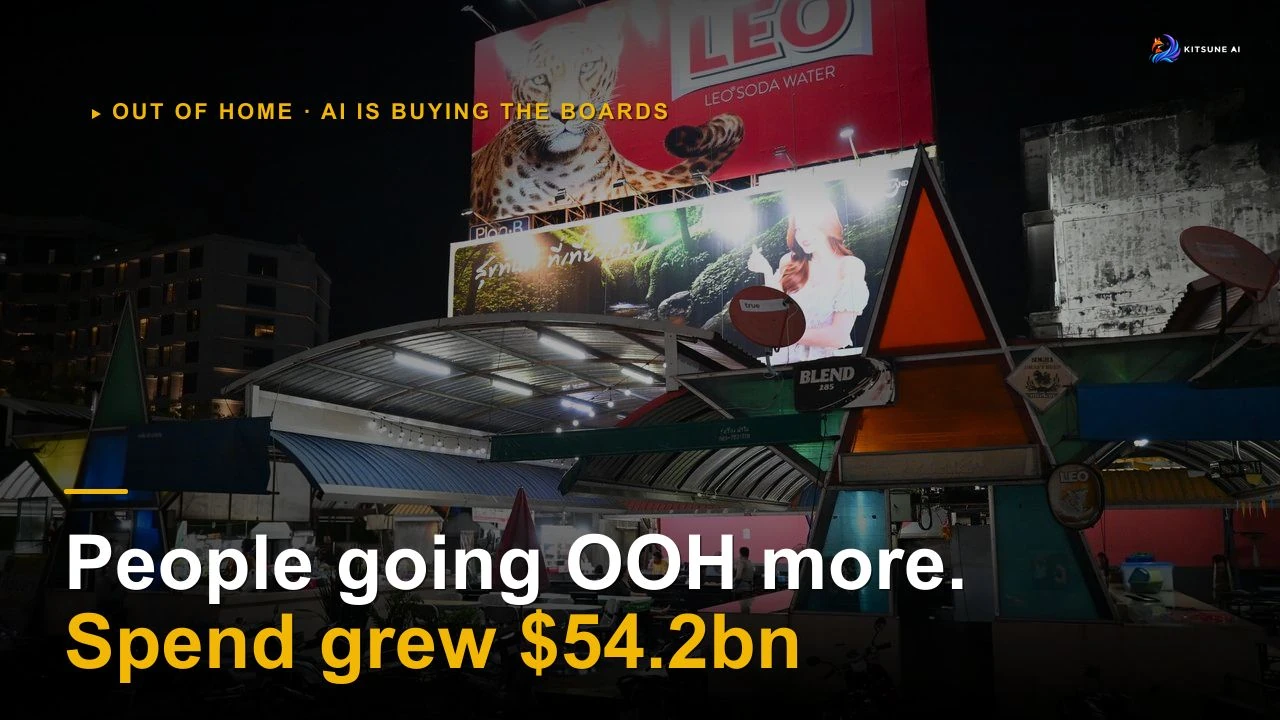
- WOO's 2026 expenditure report: $54.2 billion in 2025, 5.1% of global ad spend, forecast $56.4 billion in 2026. Asia Pacific is $29.7 billion, about 55% of the world. China is $18.2 billion. The United States is $9.5 billion.
- Digital out of home was $25.5 billion, 47% of all OOH, and WOO expects it to pass static in 2026.
- Azerion, The State of UK DOOH, fieldwork in February and March 2026: 58% said measurement and attribution uncertainty is the top obstacle to investing more. 68% had already increased their use of OOH in the past year. 61% expect to spend more in the next 12 months.
- The metrics they actually use are brand uplift (74%) and footfall (60%). Online conversions are 16%. Incrementality is 14%.
Walk any big city at dusk and you can feel why the money moved. Commuters pack platforms and bus lanes. Night markets spill onto pavements. Screens on building faces and roadside gantries light up as people leave the house again. Advertisers followed that foot traffic outdoors. The figure they can still defend in a budget meeting is brand uplift and footfall.
Spend reached $54.2 billion, and Asia holds most of it
WOO asked its members and the national OOH associations. More than 100 replies, 85 territories, about 95% of global GDP. The 2025 total was $54.2 billion, up 15% on 2024. Next year they forecast $56.4 billion.
If you only read the US trade press you will think this is a New York and Los Angeles story. North America is $10.3 billion. Europe is $10.2 billion. Asia Pacific alone is $29.7 billion, about 55% of the world total. China is $18.2 billion, almost twice the United States at $9.5 billion. Japan, the UK, Germany and France follow. The growth in share of total media was strongest in Brazil, China and South Korea. The boards people actually walk past, in volume, are in Asia.
Digital is why the total moved. DOOH was $25.5 billion, 47% of OOH. WOO expects $28 billion in 2026, 49%, the year digital overtakes static. Programmatic DOOH was reported at $2.1 billion, 8.4% of DOOH, and WOO has asked PwC to audit that slice because the industry still cannot add it up the same way twice. That last sentence is the whole buyer problem in miniature. A glowing night board can now be bought in a few clicks, and the finance team still wants the kind of proof digital has been selling for years.
58% name measurement as the reason they will not spend more
Azerion surveyed 128 planners, buyers, strategists and media owners in the UK, in February and March 2026, and published it as The State of UK DOOH. This is a UK sample. I will not stretch it into a world figure. Inside that sample, 58% said measurement and attribution uncertainty is the biggest obstacle to putting more money into OOH. The next reasons sat lower: 47% cited the difficulty of comparing OOH with digital, social and CTV, and 39% cited budget.
They are already spending. 68% increased OOH use in the past year. 61% expect to spend more over the next 12 months. 93% said the channel matters in an omnichannel plan. So the barrier sits in front of the next increase. The budget that grew is still waiting on a number a CFO will sign.
Look at which numbers they trust. Brand uplift 74%. Footfall 60%. Online conversions 16%. Incrementality 14%. The industry is judging a public screen with the two metrics it can say out loud, and almost nobody is closing the loop to a sale. Azerion also found the contradiction. Only 18% are actively unhappy with current measurement. 41% are satisfied or very satisfied. 42% are neither. People name measurement as the obstacle, then say the tools they have are fine. Rebecca Callaghan, who runs OOH at Azerion, called it a confidence gap. Ruth Reynolds, their insight director, said some of the solutions exist and are underused. I believe the operational half of that. I also know what a board does with "the tools exist, we just have not applied them." It does not release the next tranche.
I had to defend a PKR 1 billion outdoor line without a metre the CFO trusted
At Nestlé Pakistan the out-of-home and influencer budget I ran was PKR 1 billion. Outdoor was a street argument. You could show a photograph of the site, traffic on the flyover at rush hour, a footfall claim from the vendor, and a brand score if you paid for one. You walked into the same room where digital presented a cost per sale, and the hoarding never had the same paperwork. The vendor always had a reason the loop was someone else's job. The CFO did not care whose job it was.
That is the Pakistan version of the 58%. We were increasing outdoor when the city was the medium and the phone was starting to eat the plan, and the question on every renewal was the same question Azerion just surveyed. What did it do, in a unit the rest of the mix already uses? I could move money and still struggle to defend the increment. Brands that got a clean read spent again. Brands that got a footfall story and a smile spent until someone senior asked for the sale.
The AI leap fills indoor screens cheaply and makes outdoor screens easier to buy programmatically. People are out. The WOO number says advertisers followed them onto the street, past the lit boards and the commuting crowds. The buyer still has to stand up in a room and prove one board against the next. APAC already holds most of the dollars. A UK planner's 58% is the objection those dollars will hit when someone asks for the same attribution they get from a feed.
WOO is writing measurement guidelines and commissioning an audited programmatic study because the trade body knows growth will stall on this. Callaghan is right that the next wave sits behind the confidence gap. A guideline PDF will not deliver that wave on its own. It arrives when a buyer can take $54.2 billion of industry growth, point at their own slice, and show a result that survives a finance review.
The boards will keep lighting the streets. The spend will keep climbing in the WOO tables. The planners who open the next tranche will be the ones who can walk into that meeting with a metre the rest of the mix already understands.
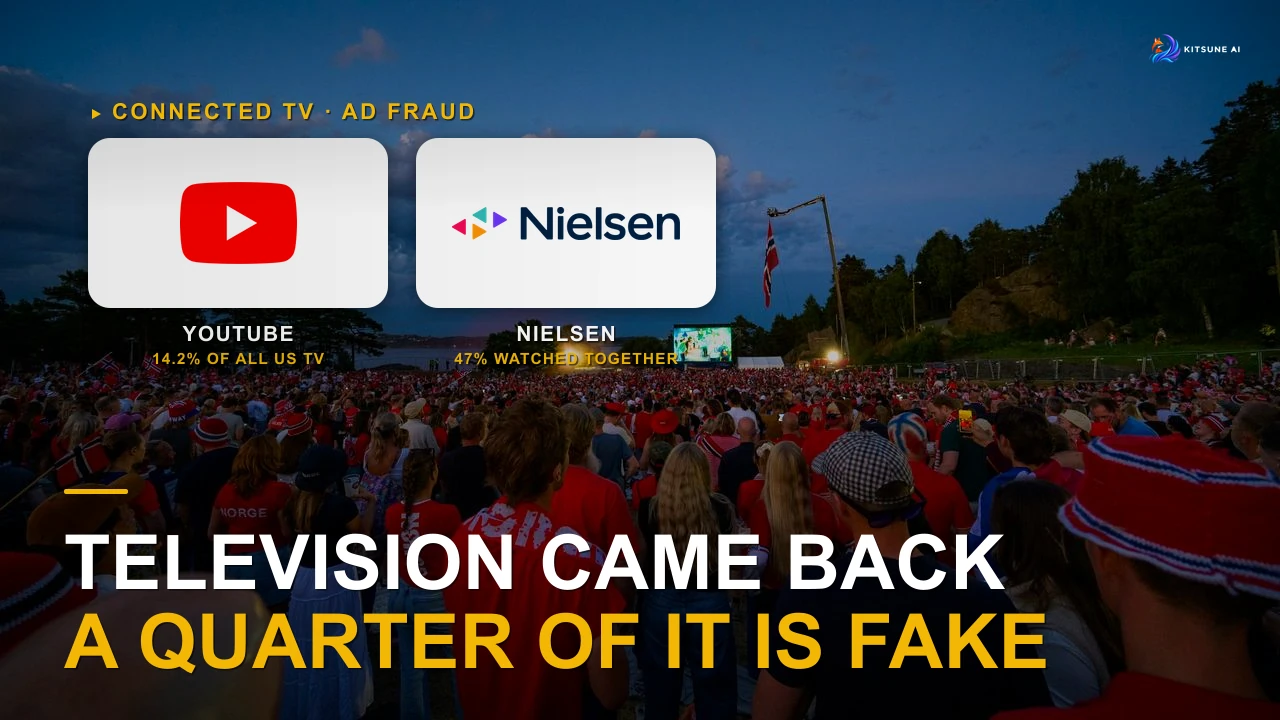
TV is not dead. It's now connected. And 25% of it is fraudulent.
Pixalate measured a quarter of the open programmatic connected TV market as invalid traffic in Q1 2026. DoubleVerify cau
Read article
Retail makes comeback as Shopify bedroom brands take a dive
Samantha Ravndahl shut the makeup brand she started in 2021. Harley Finkelstein's new Shopify names this quarter are Hol
Read article