
WNBA players are playing for power over their futures
The WNBA’s CBA ties its salary cap to league and team revenue. Most salary contracts pay for labour at an agreed rate, while the owners retain the value their businesses build.

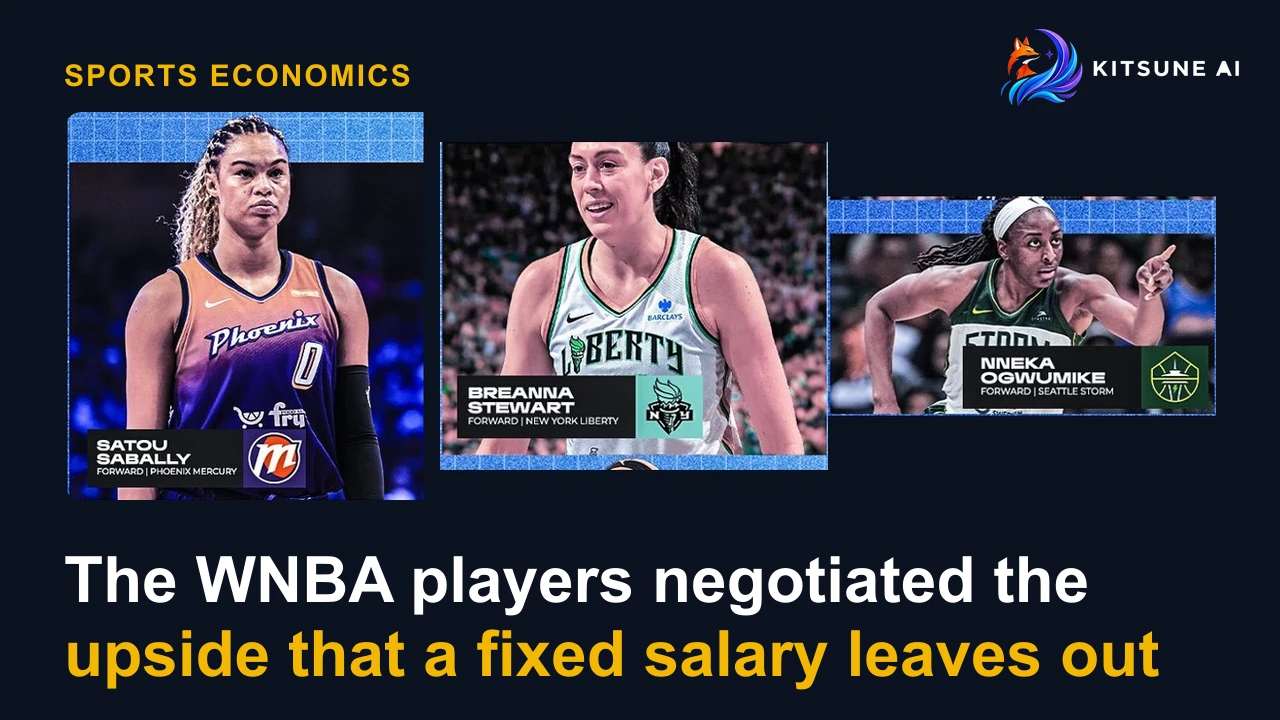
- A fixed salary sets the employer’s labour cost. Growth does not automatically change the amount owed.
- WNBA players negotiated a salary cap linked to defined league and team revenue, with accounting and audit rights.
- That is a contractual compensation formula. Franchise equity and its long-term appreciation remain with owners.
- A worker can ask for a defined share of a result before helping produce it.
Imagine an agency team renews a major client and keeps the account growing for another year. The owner’s company is worth more because the revenue is more secure. The employees still receive the salaries in their contracts. At appraisal time, they have to ask again whether any of the gain will reach them.
That is how a fixed salary is designed. It prices labour for an agreed period. Any raise, bonus or profit share needs another promise. If the company does well, its owners keep the appreciation in the business unless a contract gives someone else a claim. The employee can have done work that helped build the result and still have no formula to participate in it.
The WNBA players negotiated that formula into their collective bargaining agreement. On October 14, the league reported more than 90 million unique viewers and 3.8 million fans at games during the 2026 regular season. The audience is growing. The players’ agreement now connects a defined measure of league and team revenue to the salary cap that governs their pay.
The WNBA put revenue inside the pay agreement
The signed CBA runs from 2026 through 2032. It sets the 2026 team salary cap at $7 million. For later years, the cap is calculated from specified shares of league and team revenue, less benefits and other adjustments, then divided across the teams. The agreement limits annual cap increases and decreases. This gives player compensation a defined route to grow with the business.
The details matter. The formula sets a salary cap. Individual pay still depends on each player’s contract. Owners keep their equity in each franchise and its future value. Players gain an enforceable compensation rule through the labour agreement.
The CBA requires audited league and team statements. The WNBPA can appoint its own accountants to examine the league’s calculation and selected team records. The union negotiated access to the numbers behind the promise. That is the difference between a formula workers can verify and a bonus left to a manager’s discretion.
A company can share the result before it is known
The comparison is not that every employer should copy a sports league. WNBA players bargain collectively as a defined group whose work is central to the product. Most employees have less leverage. But a business can still decide how to reward a result before the result arrives.
A company might set a bonus against renewing a named client, hitting a gross-margin threshold or improving cash collection. It can specify who qualifies, how the amount is calculated, when it is paid and what records employees can see. The employer avoids promising a slice of revenue that disappears into costs. Workers know what performance changes their pay.
The counter is real: salaries give employees predictable income, and revenue can rise while profit falls. A company needs room to fund investment and cover a weak year. That makes the measure and threshold important. It does not require leaving every upside payment to management’s decision after employees have done the work.
The US Bureau of Labor Statistics says 51% of private-industry workers had access to some nonproduction bonus in March 2026, while 6% had access to cash profit sharing. Those are US figures, and access does not guarantee a payout. They show how often “we have a bonus plan” can mean something far narrower than a defined share of company profit.
Workers should know what growth changes in their pay
The WNBPA’s negotiation process gives players a committee, union representation and a vote on the agreement. Their power comes from acting together. An individual employee may have to negotiate a smaller promise, and the employer may say no. The business question remains useful: if workers help win and keep the revenue, what part of that gain changes their compensation?
A fixed salary answers what the company owes for the work already agreed. It says nothing about the next client renewal, the next record season or the next year of growth. The WNBA players secured a rule before that growth was counted. Every employer that wants its team invested in commercial results can make the same question part of the contract negotiation.
JEV is the perfect example of the Valley's echochamber
Jev is a fast, typed classifier. On a constrained question it returns a choice or a score, with a confidence number, and
Read article
Companies abandon AI stacks, 40% projects cancelled. Seek specialist AI firms to deliver results.
Gartner expects more than 40% of agentic AI projects to be cancelled by the end of 2027. MIT's count says the ones bough
Read article
Leaps in AI means people are going Out of Home (OOH) more. Spend grew $54.2bn.
Global out of home reached $54.2 billion in 2025, up 15% on 2024. In a UK study of 128 planners and buyers, 58% named me
Read article