
Salesforce wants more of the same marketing budget
The proposed Braze deal brings another marketing supplier into Salesforce’s business. For a brand, the benefit has to show up in the work and the total bill. Salesforce already knows how to grow the bill.

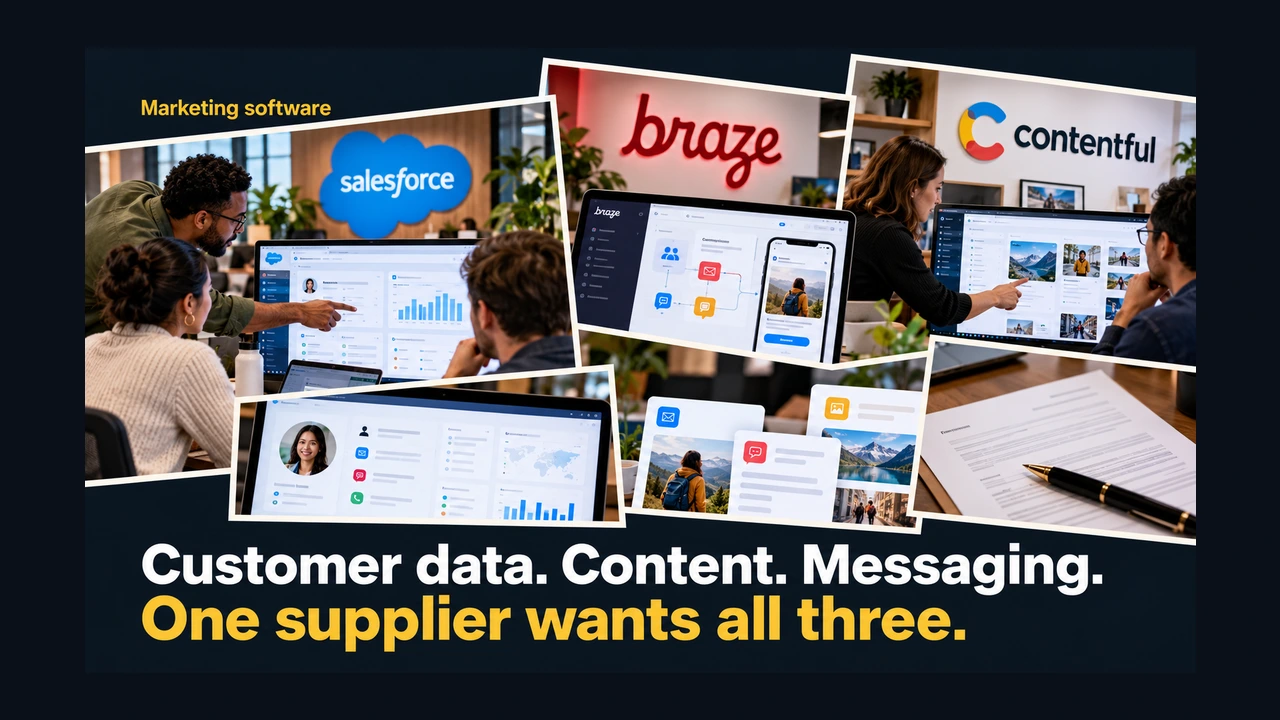
- Salesforce’s proposed Braze acquisition would give it another way into a marketing budget, alongside the Contentful business it already owns.
- Slack shows how the proposition can develop: more AI and integration in the package, with a higher price for one tier and unchanged pricing for another.
- Brands are already reducing software commitments. Buying more from one supplier only makes commercial sense when the combined operation earns its cost.
A marketing team can buy a customer database, a website content system and a tool to send messages without thinking it has made one large commitment to Salesforce. After enough acquisitions, that is increasingly what the supplier would like the team to do.
I understand the appeal of making these products work together. Anyone who has tried to get a customer list, a website and a campaign tool to agree knows how much time disappears between them. But the supplier’s answer is usually to buy more of its products. The marketer still has to explain what the business gets for the larger commitment.
Salesforce’s proposed USD 5.66bn acquisition of Braze makes that question harder to avoid. Braze handles messages and customer journeys across mobile apps, websites, email, SMS and WhatsApp. Salesforce says it serves about 2,770 customers. The transaction is expected to close in Salesforce’s fiscal 2028, subject to approvals.
That is a substantial set of relationships with people who already spend money on marketing software. Salesforce wants more of their business.
Several software decisions can end at the same supplier
Consider a retailer using one system to hold customer information, another to publish product content and Braze to manage welcome messages, abandoned baskets and repeat-purchase campaigns. This is an illustrative workflow, and a fairly ordinary set of jobs for a marketing team.
Each purchase solves a problem. Over time, customer definitions, campaign rules, product information and approval processes become embedded in those systems. Replacing a supplier means moving the work as well as the data. The subscriptions are only one part of what the business has spent.
Salesforce completed its Contentful acquisition on September 1. Contentful brings the content system into that picture. Braze would bring more of the messaging and customer-journey work. The commercial opportunity comes from joining decisions that different teams may originally have made separately.
Adobe is moving across the same budget from another direction. Its completed Semrush acquisition adds search and brand-discovery tools to a business already selling content and customer-experience systems. A marketer can now buy the explanation of why the brand is hard to find from a company that also sells products for creating and delivering the response.
There can be useful connections in both cases. There is also a clear incentive to keep the next purchase inside the family. A brand comparing suppliers has to recognise when several product names now lead to the same negotiating counterparty.
Slack shows what the offer can look like at renewal
The history is already available inside Salesforce’s own business. In June 2025, Slack changed its packaging and prices as it added AI capabilities and Salesforce integrations.
Business+ went from USD 12.50 to USD 15 per user per month for annual-billing customers. The monthly-billing rate went from USD 15 to USD 18. Pro kept its price and received additional features. Those distinctions matter. The same announcement offered a better deal to one group and a more expensive package to another.
A buyer may value the additional capabilities. Another buyer may have budgeted for the collaboration product it was already using and have little immediate use for the new additions. Both face the supplier’s revised offer. The cost of moving conversations, workflows and integrations gives the renewal a different character from a fresh software comparison.
Salesforce also announced an average 6% list-price increase from August 2025 for Enterprise and Unlimited editions of specified clouds. It excluded several other editions. The point is the pattern of commercial decisions across a portfolio: new features, new packages, different prices and a reason to have a broader conversation with the account team.
There is no announced Braze price rise in the acquisition agreement. Slack’s history shows why the eventual renewal deserves more attention than a promise that the products will connect.
Customers have already started cutting the excess
Braze’s own filings reveal the pressure on the other side of the negotiation. Its FY2026 annual report reports dollar-based net retention of 109%, down from 111% and 117% in the preceding two years.
That measure follows spending by an existing customer group, including expansion, contraction and customers leaving. It does not mean 109% of customers stayed. Braze says turnover and renewals at lower subscription levels reduced the rate. It also describes customers aligning commitments with current needs rather than buying capacity for demand they expect later.
That is a sensible response from a business paying the bills. Software sellers spent years encouraging teams to buy ahead of growth. The customer eventually has to compare what it committed to with what its people actually use.
A larger bundle can make that comparison harder. A discount on several products may look attractive while unused capacity, duplicate functions and implementation work remain. The total can still fall, particularly when a business retires other tools. The relevant saving is the cost that actually leaves the business, including the effort needed to operate the replacement.
Integration has to earn the larger commitment
Salesforce says Braze will remain part of an open, composable approach. That is useful for teams with existing systems and a reason to examine the eventual integrations properly. A working connection can reduce manual handling, speed a campaign and give staff a more reliable view of the customer.
Those benefits need people responsible for delivering them. A signed software agreement cannot resolve an argument about which customer record is correct, who approves an offer or what a campaign is supposed to achieve. Adding products can leave those decisions exactly where they were while creating another implementation programme.
The brand also has an asset worth protecting: its knowledge of its customers and the rules by which it serves them. When that knowledge is documented and usable across systems, the business has more room to choose suppliers. When it exists mainly inside a vendor’s workflows, changing suppliers becomes a much larger operating decision.
I would welcome a simpler marketing operation. Fewer broken connections and less repeated work are worth paying for. But a simpler supplier presentation is easy to produce. The harder achievement is a brand team that can do better work with a lower total cost and a clear understanding of what it has bought.
Salesforce can earn a larger share of the marketing budget by making that happen. An expanding list of acquired products gives it more opportunities to sell. The customer still needs a reason to keep paying.
Publicis's LiveRamp deal makes agency neutrality harder to sell
Publicis already owns an agency network and Epsilon. A LiveRamp deal would put a key data connector used by other agenci
Read article
Websites matter again, because AI cant read social or video
Brands spent years moving the customer relationship into somebody else’s feed. AI is giving the website a job again, and
Read article
Apple blocks another ads route for brands
Apple has blocked a specific identity-resolution route in WebKit 27. Another dollar in the chain is eaten up by consumer
Read article
Netflix is duping creators by 'test' before they pay up
It is pitching creators the platform as a distribution channel, with a conditional payout attached. Creators are jumping
Read article