
Global FMCG demand dries up, growth now comes from price hikes
A higher grocery bill can make a food company’s sales look healthier than its customer base. The harder question is what people stop buying, what they buy instead and whether the next growth bet understands either.

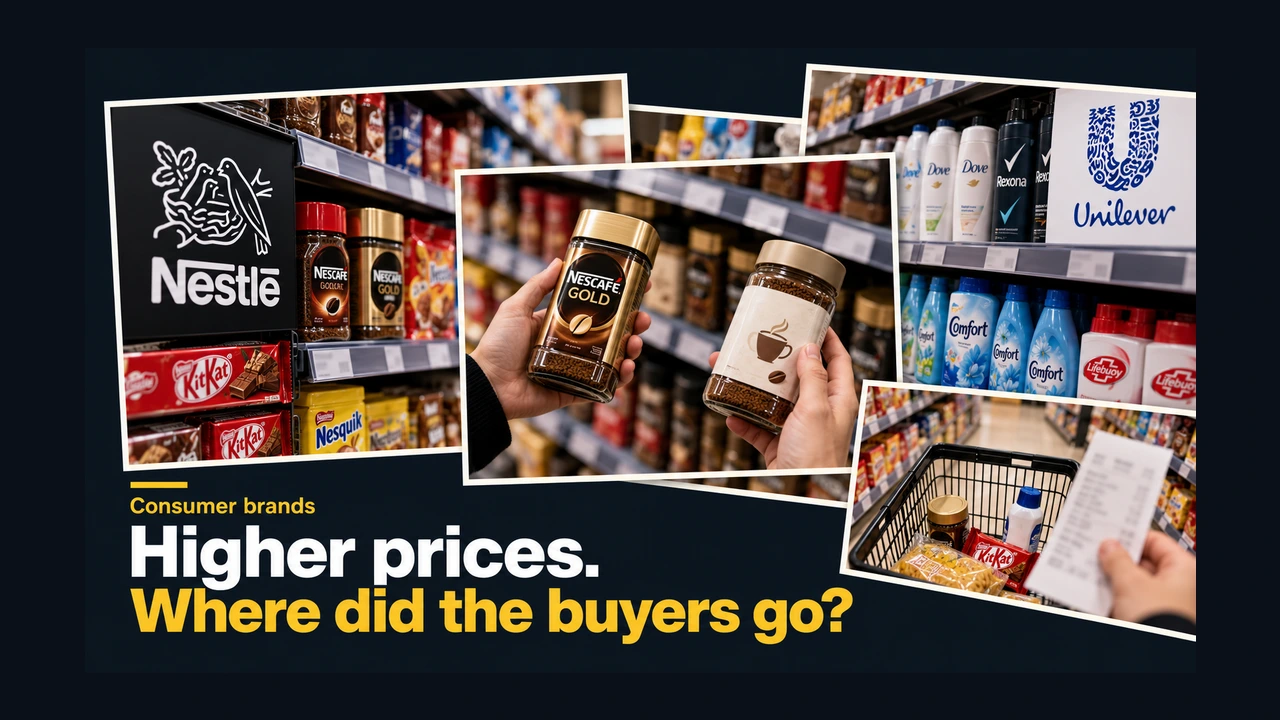
- Nestlé’s multi-year results show how much price increases can contribute to growth while volume and product mix barely move.
- Consumers respond by changing the basket, the shop and the brand. Private-label growth gives retailers a direct interest in that movement.
- Winning those customers back requires a better offer and sound investment decisions. More expensive products and optimistic forecasts cannot keep doing the work of demand.
There is a convenient way for a large consumer business to report growth without persuading many more people to buy its products. Charge the existing customer more. For a while, the sales number grows and the business can describe itself as resilient.
The customer is doing a different calculation. The household has to buy food, pay for transport and keep enough money for the rest of the month. A familiar brand now competes against the cheaper pack beside it, the retailer’s own product and the decision to leave something out of the basket.
I think big FMCGs have spent too long reading the first calculation as evidence that the second one will keep working in their favour. The danger appears when a company mistakes its ability to pass on a price increase for a customer’s willingness to accept the next one.
Nestlé’s growth depended heavily on charging more
Nestlé’s 2022 results put the relationship plainly: 8.3% organic growth, with 8.2% pricing and just 0.1% real internal growth. In 2023, pricing was 7.5% while real internal growth fell 0.3%.
Real internal growth includes volume and product mix. It is the company’s measure of what happened beyond pricing, and it shows why a growing sales value can conceal a much weaker consumption story.
Input costs were rising. A manufacturer has to protect its economics, and absorbing every cost increase is hardly a durable alternative. But a price decision changes the offer the consumer sees. Repeating it requires confidence that the product still earns its place in the household budget.
In 2025, Nestlé again reported 0.8% real internal growth alongside 2.8% pricing. There is a substantial difference between finding more demand and collecting more money from the demand already there. A marketing organisation that only celebrates the combined sales number can miss what is happening underneath it.
The shopper changes the basket before abandoning the category
Food demand does not need to disappear for a big brand to lose. A family can keep buying the category while changing the brand, pack size, shopping frequency or retailer.
Circana’s US grocery analysis, drawing on data through Q2 2024, found more quick shopping trips and fewer items on those trips. It also described growth at both ends of the market: private label and premium products gained while mainstream brands weakened. Consumers were making choices within their budgets, including choosing where an upgrade was worth paying for.
That is an uncomfortable position for a large middle-of-the-market brand. The shopper can economise on one product to keep buying another they care about more. The brand that once looked like the dependable default now has to explain its price against both alternatives.
NIQ’s 2025 global research found that 53% of respondents said they were increasingly buying private-label products. It also reported growth among the top ten global brands. Scale still has value. Its protection depends on what the customer believes the brand gives them for the money.
Retailers have a useful advantage in this contest. They see the basket and control the shelf. Their own products can sit beside the brands that helped build the category, with a price comparison visible at the moment of choice. The FMCG company may be buying another campaign while the retailer is improving the alternative right next to its product.
Those international findings do not supply a Pakistan market-share table. They do establish a more useful question than whether consumers still need groceries: which offer wins the purchase when the household has to reconsider it?
Pakistan shows what happens when the shelf price jumps
Nestlé Pakistan’s 2024 results reported a 3.7% sales decline to PKR 193.2bn. The company said the 18% GST passed to consumers across most of its portfolio reduced demand.
The source of that increase was taxation. The customer still met it in the selling price. A brand can have a reasonable explanation for charging more and lose the purchase anyway.
The local company subsequently reported revenue recovery. Its third-quarter 2026 financial report records nine-month sales growth of 6.3%, alongside work on brands, innovation, exports and pricing. The report does not break that revenue growth into units and price. The rupee total therefore cannot answer how much more product households bought.
For a marketer, that distinction belongs in the business discussion. If consumers are stretching a pack or dropping a purchase, a campaign that delivers impressions cheaply can still arrive at an offer they cannot accommodate. Product relevance, pack sizes, price points and availability decide whether the attention has somewhere useful to go.
Forecasting the next habit can be an expensive mistake
A separate risk appears when a company buys a business on an optimistic forecast of a new eating habit. Prepared-meal delivery provides a documented example. Its economics depended on repeat orders and the cost of acquiring customers, with a different proposition from the alternative-protein products that also attracted investment.
Nestlé’s 2020 acquisition of Freshly valued the prepared-meal delivery business at USD 950mn, with up to USD 550mn in additional contingent payments. The proposition was a convenient meal delivered to the home. The investment depended on enough customers continuing to buy that service at workable economics.
Nestlé Holdings later recorded a USD 311mn goodwill impairment in 2022, mainly relating to Freshly. Its explanation described performance below projections and difficulty acquiring customers. The impairment reduced the recorded value of the business. It is a concrete example of expectations being revised after the investment.
Alternative proteins involved different bets. Nestlé’s cultured-meat announcement described exploratory work with external partners. Garden Gourmet’s UK retail range ended in 2023, while the foodservice business continued. Prepared meals, plant-based products and cultured meat have different products, customers and cost structures.
What connects those decisions is the need to understand repeat demand before assuming a fashionable category will supply it. A promising market forecast can support a presentation long before it supports a profitable habit. Large companies have enough capital to make that misunderstanding very expensive.
Volume growth is possible when the offer earns it
There is evidence of recovery. Nestlé’s latest nine-month results show real internal growth improving, with 2.8% in Q3. Unilever’s first-half 2026 results were strongly volume-led: 4.2% underlying volume growth within 4.8% underlying sales growth. Those measures include mix, and neither is a count of individual units sold.
The improvement shows why the consumer deserves more attention than the story of an exhausted category. People continue to choose. Companies can gain when their products, distribution and investment meet those choices more effectively.
For big FMCGs, the damaging assumption is that yesterday’s household habit guarantees tomorrow’s purchase. Price increases test that habit. Retailer alternatives compete with it. New categories ask the company to understand another one from the beginning.
Marketing belongs inside those decisions. The brand has to offer enough value for a customer to keep choosing it after the price, the available alternatives and the household budget have changed. Growth that depends on that choice is harder to manufacture in a presentation. It is also the growth a consumer business can keep.

Fox's AdStudio integrates into digital buying systems for top agencies
Fox has put live television buying into the systems five major agency and media partners already use. The next commercia
Read article
Apple blocks another ads route for brands
Apple has blocked a specific identity-resolution route in WebKit 27. Another dollar in the chain is eaten up by consumer
Read article
Netflix is duping creators by 'test' before they pay up
It is pitching creators the platform as a distribution channel, with a conditional payout attached. Creators are jumping
Read article
Publicis's LiveRamp deal makes agency neutrality harder to sell
Publicis already owns an agency network and Epsilon. A LiveRamp deal would put a key data connector used by other agenci
Read article