
The Pakistanis Quietly Building the Machines That Replace Work
The country that sells the most human work on Earth is also producing the people building the machines that end it. That is not irony. It is a signal nobody is reading.
- Pakistan is the world's #2 supplier of digital labour, with freelance exports up about 50% year over year.
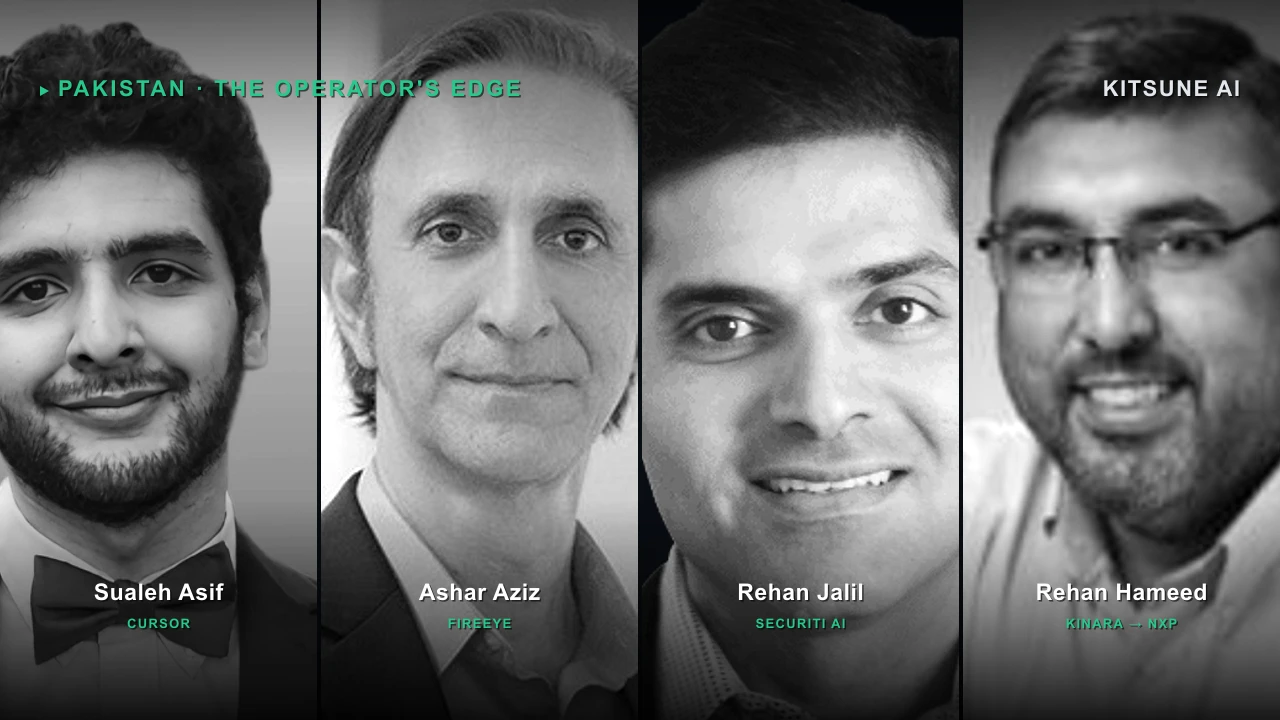
- The same month SpaceX agreed to buy Cursor for $60 billion, it is worth remembering who co-founded Cursor: Sualeh Asif, from Karachi.
- Growing up where nothing works out of the box trains the exact instinct an agentic system runs on. I call it jugaar, and it is systems-thinking under constraint.
- The bet worth making: the next decade's export shifts from Pakistan's hours to the machines themselves, if we keep the deed.
Start with a number
Pakistan is the world's second-largest supplier of digital labour, with freelance exports of roughly $959 million in ten months of FY2025-26, up about 50% year over year across some 2.37 million registered freelancers.
And yet the comfortable read is that this is a cheap-hours story. A back office. The place you outsource the work nobody at headquarters wants.
Let that sink in. The country selling the most human hours into the global economy is also producing the people building the machines designed to end the hours-for-dollars trade entirely.
Read it the right way and it stops being a contradiction. It starts being a clue.
Connect the dot everyone walked past
Two weeks ago the whole industry watched SpaceX agree to buy Cursor for $60 billion, and spent its attention on Elon. Look one name down the cap table. Cursor was co-founded by Sualeh Asif, born in Karachi, Nixor College to MIT, who represented Pakistan at the International Mathematical Olympiad three years running.
Sit with the shape of that. The most valuable AI coding tool on the planet, the one a rocket company just paid a fortune to own, was co-built by a kid from a city that loses power for hours a day. And he is the leading edge of a pattern, not the exception you wheel out for a feel-good story.
Rehan Hameed went NUST to a Stanford PhD and co-founded Kinara, an edge-AI chip company NXP bought for $307 million in cash, a deal that closed at the end of October 2025. Two names. Two dated outcomes. I will not pad the list with rumored insiders I cannot verify, because the pattern holds on the receipts.
What jugaar actually is
Here is the better question than "where does the next automation giant come from." What kind of childhood manufactures the instinct to automate?
In Pakistan you grow up where nothing works out of the box. The power cuts, so you wire an inverter and a battery and keep the fans running. The official path is jammed, so you find the one around it. The tool does not exist, so you build it.
We call this jugaar. The idea is older than us and shared across South Asia (the word jugaad was coined in India, meaning making things work with limited means through clever fixes and sheer will). Our contribution may be that we industrialized it.
The West hears jugaar and pictures duct tape. That is the lazy version. Jugaar is systems-thinking under constraint. When you have no resources to throw at a problem, you are forced to understand the whole machine, every dependency and failure point, and route around the broken part. Read that back and tell me it is anything other than the job spec of an agentic system. The kid rewiring the house during load-shedding and the engineer wiring an autonomous agent are running the same program. One does it with copper. The other does it with a model.
The part I do not say out loud often
I grew up watching my elders treat constraint as ordinary, as unremarkable as a Tuesday. The fridge stops cooling and someone in the family just knows a guy, or becomes the guy. You learn early that the world ships incomplete and the finishing is your job.
I did not see the value of that until I left, and watched how many brilliant people simply assume things will work, and freeze when they do not. That freeze is the gap. We were never given the option to freeze. Somewhere along the way that stopped being a burden and became the most useful reflex you can have in a field where every system is half-built and the documentation lies.
I would not trade that childhood. It built the founder.
Sovereign is just another word for owned
And the instinct is no longer only bottom-up. The state is starting to point the same direction.
In July 2025 the federal cabinet unanimously approved a six-pillar National AI Policy, authored by the Ministry of IT, MoITT. The government then put weight behind the words. It adopted the Islamabad AI Declaration on sovereign, responsible AI in February 2026, presented by IT minister Shaza Fatima Khawaja, launched the AI Seekho upskilling program with Google that April, and the Prime Minister committed a billion dollars to AI with a target of a million Pakistanis trained by 2030.
Read the word they chose. Sovereign. The official language for the thing I have been describing the whole way down, the gap between owning your stack and renting it, is sovereign AI. The government picked the right noun. (read: the deed, at national scale.)
I will keep it honest. A policy is paper until it ships something, a pledge counts only when the invoice clears, and a 2030 target is a long way from a result. The hard part is execution, and that is still ahead. But direction is what you bet on early, and for the first time the bottom-up instinct of the builders and the top-down intent of the state are pointing at the same thing.
The bet worth making
Here is where the dots actually lead, and it is a bigger claim than "Pakistanis are good at tech."
The lazy future has Pakistan gigging on automation platforms, trading cheap hours for slightly less cheap hours, renting its hands to someone else's machine. Forget that future. Look at what Asif and Hameed actually did. They owned a piece of the machine. The shift that matters is from selling hours to owning systems.
And the country is sitting on exactly the raw materials for it. Surplus power that meant nothing now means cheap compute. The 230 million people who speak our languages are a moat no foreign lab has bothered to cross. The millions of freelancers everyone files under cheap labour are the largest pool on Earth that already knows how to ship work to a global standard. Point that pool at building and owning agents instead of renting their hours, and the math stops being about wages at all.
For decades the world rented Pakistan's hands. The next decade runs on machines Pakistanis are already helping build. The only question that decides who gets rich is whose name ends up on the title.
So stop asking which zip code the next automation giant comes from. Ask who grew up never trusting the default. Then ask the harder one, the one that actually settles it. Did they keep the deed.

Has Elon Finally Assembled the AI Equivalent of a Royal Flush With the Cursor Acquisition?
SpaceX buying Cursor looks like one more shopping-spree headline. Lay it next to the other cards Elon is holding and you
Read article
Is YC Funding Rails for the One Thing Built to Break Them?
The whole batch is betting agents need plumbing, the way every era before them did. From where I build, that looks like
Read article