
Has Elon Finally Assembled the AI Equivalent of a Royal Flush With the Cursor Acquisition?
SpaceX buying Cursor looks like one more shopping-spree headline. Lay it next to the other cards Elon is holding and you can almost see the whole hand. Almost.
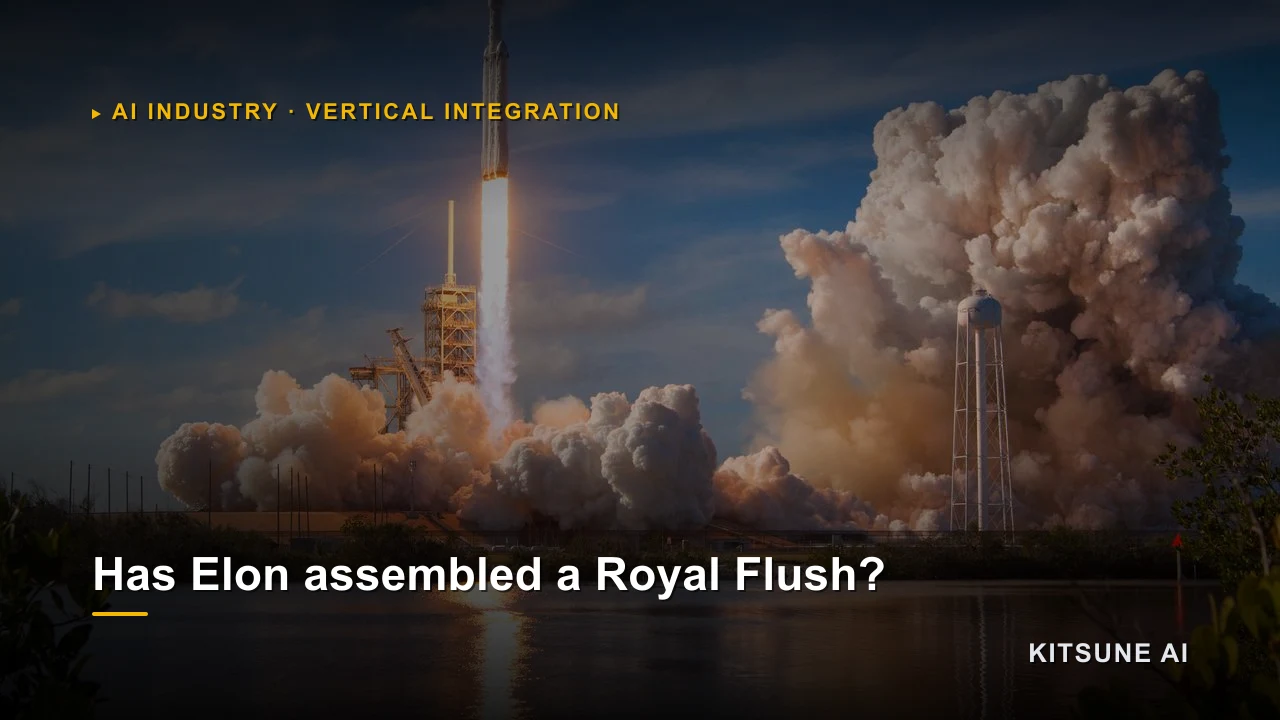
- SpaceX agreed to acquire Anysphere, the maker of Cursor, for $60B in all-stock on June 16, 2026 (pending a Q3 close).
- On its own it reads as consolidation. Next to everything else Elon owns, it is another card in a hand he has been collecting one layer at a time: power, compute, model, editor.
- The hand looks unbeatable until you notice one card is borrowed. Every layer still runs on Nvidia silicon, which is why he announced a $25B fab to print his own.
- A Royal Flush is unbeatable because the cards are worth more together than apart. The only player who can still beat Elon is the one dealing him chips.
The deal everyone filed under "consolidation"
Sixty billion dollars for a code editor. And yet the number is the least interesting thing here.
On June 16, 2026, SpaceX agreed to acquire Anysphere, the company behind Cursor, in an all-stock deal expected to close in Q3. The reflex take wrote itself. Another giant swallows another startup, cue the antitrust hand-wringing, file under consolidation, move on.
That reading misses the plot.
Cursor is a card. Elon has been collecting them one at a time, and once you see the hand he is holding, the price stops looking expensive. It starts looking like the going rate for the one card that completes the flush.
So flip the question. Forget "why would a rocket company buy a code editor?" The one that matters is simpler: what is the hand worth once this card is in it?
The card at the bottom: power
Start at the bottom of the stack, with physics. That is where this gets genuinely interesting.
Every AI company on Earth shares one ceiling, and it is built out of power. xAI's Colossus cluster in Memphis is the proof. It draws hundreds of megawatts, and the buildout ran so far ahead of the local grid that xAI bolted on a fleet of gas turbines and caught a 2025 lawsuit for running over 400 megawatts of them without permits. The grid operator said plainly it could not meet the demand. That is the wall the whole industry is about to hit.
Watch how Elon goes through it. In January 2026, SpaceX filed with the FCC for authority to launch up to a million satellites built to work as orbital data centers, and showed the hardware behind the vision: the "AI1" compute satellite, wider than a Boeing 747, carrying a 120-kilowatt compute payload with swappable chip housings.
Look at what that solves in one move. In the right orbit the sun never sets. No night, no clouds, no atmosphere in the way. Near-constant solar, the cleanest power there is, free at the point of generation, lifted up there by the company that already owns the cheapest ride to orbit on the planet.
The cooling is the hard half, and I won't pretend otherwise. The vacuum insulates, so shedding that much waste heat by radiation alone has never been done at this scale, and Musk made no promises on timing. It is a bet. A serious one. The whole foundation rests on a single wager: pull the power from the sun, throw the heat into the cold of space, and close the energy loop in orbit where no grid gets to say no.
The rest of the suit
Trace the hand. SpaceX makes the power and owns the launch. xAI folded into SpaceX in early 2026, so the same entity now owns Grok, the model. The model needs a workspace, and a code editor is the most intimate one in software, the place the model and the human actually build together. Buy Cursor and the interface card is down. Power, compute, model, editor, every layer in one suit, held by one player.
A near-complete hand, collected one card at a time.
And here is the part worth sitting with. The cards are worth more together than apart. The power makes the compute cheaper. The compute makes the model bigger. The model makes the editor smarter. A smarter editor pulls more people onto everything beneath it. (read: a flywheel, where every turn feeds the next one.) Hold any single card alone and you overpaid. Hold the suit and each one pays down the rest.
The card he is still renting
Then you count the cards again, and one of them is borrowed.
Every layer he owns still runs on chips he buys from someone else. Grok trains on a Colossus cluster stacked wall to wall with Nvidia Blackwell, and Musk's own target is fifty million H100-equivalents over five years. Even the orbital data center launches on Nvidia first, with the SpaceX CFO admitting the custom silicon comes "longer-term." The most important card in the deck, the processor every other card sits on, is still dealt to him by Jensen Huang.
So watch what he does about it, because it is the most Elon answer imaginable. You cannot acquire Nvidia and you cannot buy TSMC. So in March 2026 he announced Terafab, a roughly $25 billion plan to print his own 2-nanometer chips across Tesla, SpaceX and xAI, and quietly restarted the in-house Dojo program with no Nvidia in it. He is building the press that prints the missing card himself.
The flush is not complete until that fab runs. Until it does, the most vertically integrated hand in AI has exactly one weakness, and it belongs to the one player at the table still dealing him cards.
Google Renamed Its Coding Tool Into the Agent Era. Then I Ran Out of Credits.
Antigravity 2.0 refuses to call itself an IDE. It wants to be an "agent orchestration system." That rename is
Read article
Is YC Funding Rails for the One Thing Built to Break Them?
The whole batch is betting agents need plumbing, the way every era before them did. From where I build, that looks like
Read article