
Why we passed on twenty years of tech fads
Crypto, VR, the metaverse, no-code — for two decades the smart money kept pointing at the future, and we didn’t move. It wasn’t caution. It was a test — and nothing passed it until now.

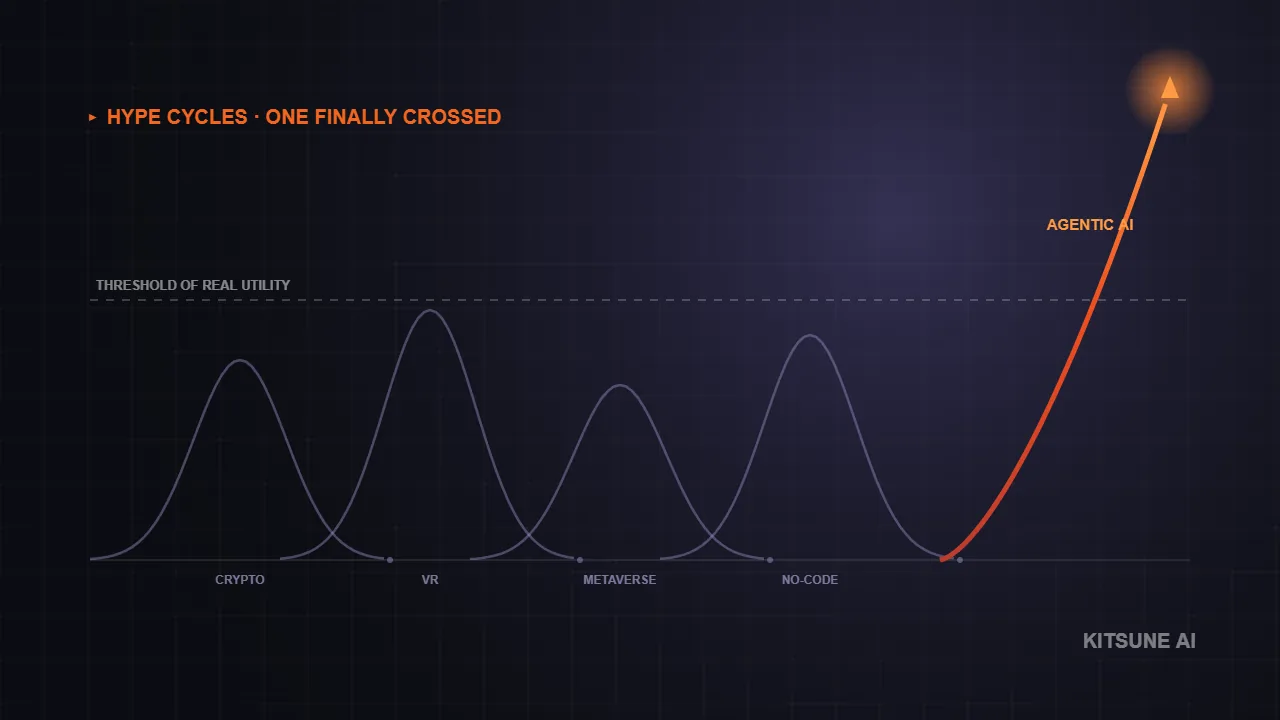
For twenty years the smart money kept pointing at the future — crypto, VR, the metaverse, no-code. We didn’t move. Not caution: a test. Can this do real, valuable work for a real business today, without everyone else adopting first? Nothing passed — until agentic AI. Saying no for two decades is exactly what let us say yes completely.
For two decades, the smart money kept telling us where the future was. Crypto would rewrite finance. VR would replace the screen. The metaverse would replace the office. No-code would replace the developer. Each arrived with a deck, a conference, and a wave of people insisting that if you weren’t building on it, you’d be left behind. We weren’t, and we weren’t.
That wasn’t caution for its own sake. It was a test — the same test, every time — and until very recently, nothing passed it. Then something did. The story of why we waited so long is also the story of why we moved so hard when we finally moved.
The test we applied to every wave
The question was never “is this exciting?” or “is this getting funded?” Plenty of dead-end technologies are both. The question was narrower and harder: can this do real, valuable work for a real business today — not in some promised future where the infrastructure finally arrives?
That single filter kills most hype. A technology that needs everyone else to adopt it first before it’s useful to anyone has to clear an almost impossible bar. A technology that’s genuinely useful the moment one company picks it up spreads on its own merits. We were only ever interested in the second kind.
If it only works once everyone believes in it, it’s a religion, not a tool. We build with tools.
What the fads had in common
Look closely and the cycles rhymed. Each promised to replace something that already worked, demanded enormous coordination before delivering value, and asked you to believe in the destination because the present was so thin. The actual capability always lagged the narrative by years — sometimes forever.
Crypto built remarkable infrastructure in search of a problem ordinary businesses actually had. VR and the metaverse asked people to trade something convenient for something worse but novel — Meta poured tens of billions into Reality Labs and the daily-use case still hasn’t arrived. Google Glass, 3D TV, the chatbot gold rush of 2016: same shape. No-code genuinely helped at the edges but quietly broke the moment real complexity showed up. None of them failed because the people were unserious. They failed the test: they couldn’t do valuable work for a real business, unassisted, today.
Not a better demo. A technology that could absorb the messiness of real operational work and produce value on day one — without everyone else having to believe first.
What changed with agentic AI
Then the capability crossed a line the narratives never had to. Models stopped being clever autocomplete and started being able to take a real, ambiguous task — read the context, make a judgment, take an action, handle the exception — and carry it to a useful end. Not in a demo. In the actual mess of a real business, against the actual exceptions that break everything else.
That was the threshold. For the first time, the thing in front of us could do valuable work for a real company the day it was deployed, with no coordination cost and no act of faith required. One business could adopt it and benefit immediately, regardless of what anyone else did. It passed the test that twenty years of fads had failed.
Why the wait was the point
It would be easy to read two decades of sitting out as timidity. It was the opposite. Saying no to every wave that didn’t pass the test is what kept us sharp enough to recognize the one that did — and to commit completely when it arrived, instead of hedging like people who’d been burned chasing the last four.
Conviction isn’t the same as enthusiasm. Enthusiasm shows up for every cycle. Conviction waits, watches, applies the same unglamorous test over and over, and then moves without hesitation the moment something clears it. We spent twenty years saying no so we could say yes to this with everything we have.
Programmatic: The Real Opportunity No One Talks About
Strip back the jargon and the real prize isn’t cheaper display — it’s inverting the $80 billion TV market.
Read article
Creator Economy 2030 — Whitepaper
Influencer marketing is dead. The seven structural shifts reshaping media, commerce and culture by 2030.
Read article