
Where a business is quietly losing money — and how we find it
Ask leadership where the money leaks and they’ll point at the org chart. It’s never there. The real cost is invisible — and the unglamorous work of finding it is the whole job.

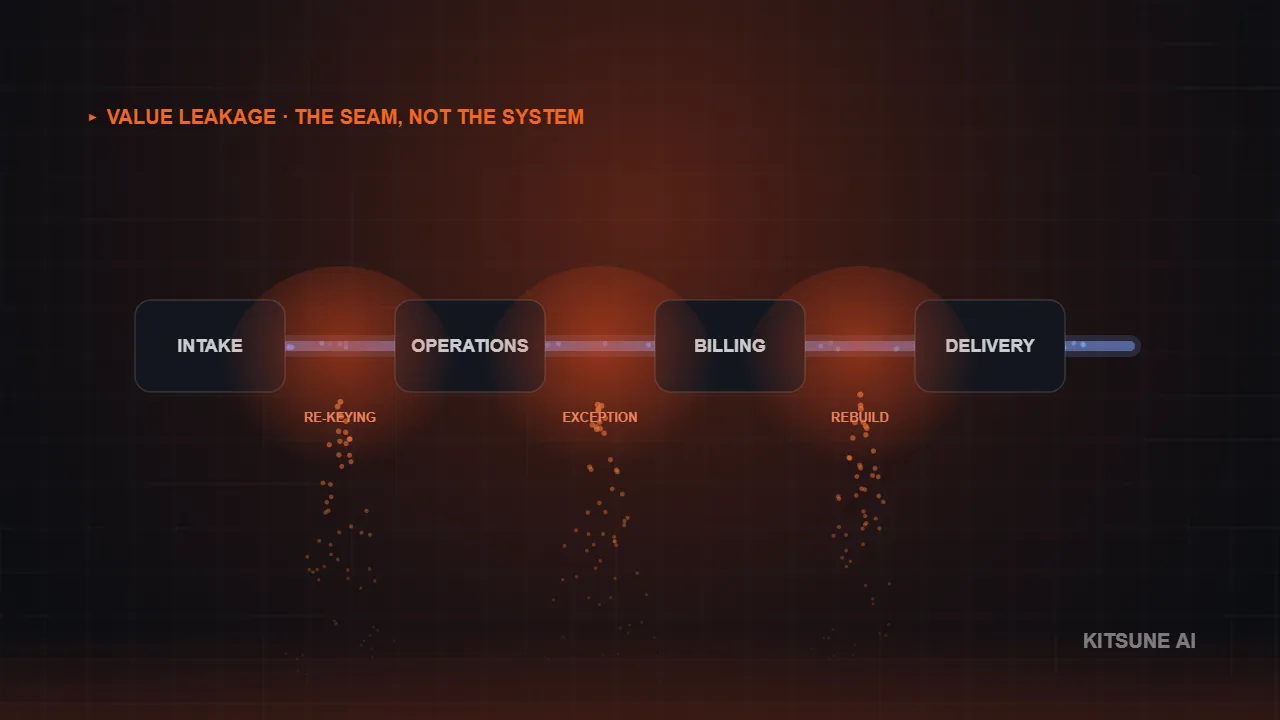
The biggest cost in most businesses is invisible — it hides in the seams between systems and people, not in any line item. Before we build a single agent, we trace one real unit of work end to end, separate the minutes of effort from the days of waiting, and put a number on the leak. Automating a broken process just lets you be wrong faster. Find the leak, measure it, then build.
Every business I walk into is already paying for a problem it can’t see. Not in a line item — in the gaps between line items. A handoff that takes three days because it sits in someone’s inbox. A report four people rebuild by hand every Monday. An exception that quietly routes around the system entirely. None of it shows up in the P&L as “waste.” It shows up as normal.
Ask leadership where the money leaks and they’ll point at the org chart — a team, a function, a cost center. After enough of these engagements, I can tell you it is almost never there. The org chart tells you who reports to whom. It tells you nothing about how value actually moves through the business, because work doesn’t respect boxes and lines. It cuts across them, doubles back, and pools in places nobody owns.
Follow the work, not the org chart
Lean manufacturing has a word for this: gemba — you go to where the work is actually done and watch it happen, instead of theorizing about it from a conference room. We do the white-collar version. We take one real unit of work — an order, a claim, a lead, a piece of content — and we follow that single thing through every hand it passes through, every queue it waits in, every tool it gets copied into and out of. We time it. We count the touches.
The question is never “what does this team do?” It’s “what happens to this one thing, and where does it wait?”
What you find, almost without exception, is that the actual work takes a fraction of the elapsed time. A task with forty minutes of real human effort takes four days to complete — because thirty-nine of those minutes are work and the rest is waiting. Waiting on an approval. Waiting on a file. Waiting on the one person who knows how the exception is handled. The effort was never the problem. The seams were.
Three places the money is almost always hiding
The industry changes; the shape repeats. When we map a process end to end, the leakage clusters in three predictable places.
1. The re-keying tax
The same information gets entered, copied, reformatted and re-entered across four or five systems that don’t talk to each other. Each copy is a chance to introduce an error, and every error downstream costs more than the keystroke that caused it. It’s the most invisible cost in most businesses because everyone treats it as “just part of the job.”
2. The exception swamp
The happy path is usually fine. It’s the exceptions — the 15% of cases that don’t fit the template — that consume the majority of the effort. They get escalated, they wait for judgment, they route around the official process. Nobody has mapped them because, by definition, they’re irregular. That’s exactly why they’re expensive.
3. The Monday-morning rebuild
Somewhere in every company, a capable person opens a spreadsheet and spends hours assembling a report the business already has the data to produce. They pull from three dashboards, reconcile by hand, and email a PDF. Then they do it again next week. The work has no owner and no system — so it never gets fixed, only repeated.
Why we measure before we automate
It’s tempting to skip this. The leak often looks obvious once you’ve seen a few businesses, and the pressure is always to get to the building. But there’s an old line from Bill Gates I keep coming back to, because it’s the entire thesis of this work:
Automation applied to an efficient operation will magnify the efficiency. Automation applied to an inefficient operation will magnify the inefficiency.
Point an elegant agent at a broken process and you don’t fix the process — you industrialize the breakage. So we quantify the leak first: how many hours per week against this specific seam, how many errors at what downstream cost, how much elapsed time and how much of it is pure waiting. That figure is what tells us whether an agent is worth building at all — and it’s the only honest way to prove the impact afterward. If we can’t measure the leak before, we can’t prove the win after.
Only then do we design. And when we do, the agent isn’t pointed at “the department” in the abstract. It’s pointed at one specific, measured seam — the re-keying between two named systems, the exception queue that backs up every Thursday, the report nobody should be building by hand.
The unglamorous part is the moat
Anyone can buy a model. The difference between an AI project that moves a real number and one that produces a slick demo is almost always upstream of the technology — in how precisely you understood the problem before you reached for the tool.
That’s the part legacy consultancies skip because it doesn’t bill well, and the part SaaS vendors skip because their product is the same no matter what your problem is. We start there on purpose. Find the leak, measure it, then — and only then — build the thing that seals it.
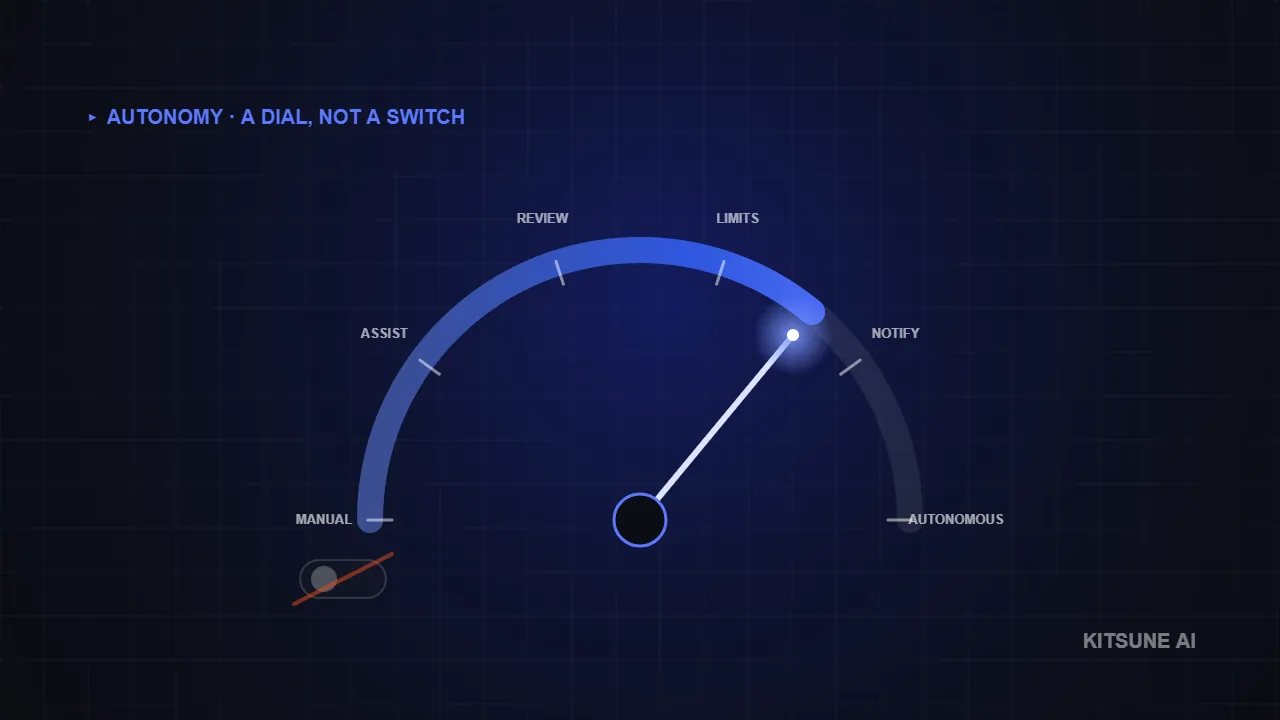
When should AI act on its own — and when shouldn’t it?
Autonomy is a dial, not a switch. How to set it per decision and keep the boundary yours.
Read article
The Agentic Survival Blueprint for Media Agencies
When a machine plans in 10 minutes what a team does in 2 days, you haven’t gained speed — you’ve lost pricing power.
Read article