The Only Card Elon Can't Buy
He can acquire a code editor, a model lab, even a launch company. He cannot acquire the one thing every layer of his AI empire runs on. So he is building it.

- The read going around is that SpaceX buying Cursor completed Elon's vertically integrated hand. It does not. One card is still borrowed: the silicon.
- He cannot acquire it. You cannot buy Nvidia or TSMC. So in March 2026 he announced Terafab, a 2nm fab across Tesla, SpaceX and xAI, now budgeted past $55 billion and built with Intel.
- The prediction worth making is not his next acquisition. It is whether he can fire Nvidia, and when.
- Watch for the first wafer out of Terafab. That is the day the hand is complete.
The hand has a borrowed card
Fifty million GPUs. That is the number Musk put on xAI's five-year compute target, and it sounds like total dominance until you notice who makes all fifty million of them. Not him.
I wrote recently that Elon has been collecting the cards of a vertically integrated AI empire one layer at a time: the power, the launch, the model, and now, with the $60 billion Cursor deal, the editor. Every layer under one roof. A near-perfect hand.
Then you count again. Every one of those layers runs on a chip he buys from someone else. Grok trains on an Nvidia-only Colossus. The cars run on TSMC and Samsung silicon. Even the new orbital data center launches on Nvidia first. The most important card in the deck, the processor everything else sits on, gets dealt to him by Jensen Huang.
That is the one card Elon cannot simply buy.
You cannot acquire the thing he needs
Here is what makes this different from every other move he has made. Cursor had a price. xAI had a price. SpaceX could write the check. The chip layer has no startup to swallow that would solve it. The two companies that actually matter, Nvidia and TSMC, are not for sale at a price any regulator would allow, and would not sell if they were.
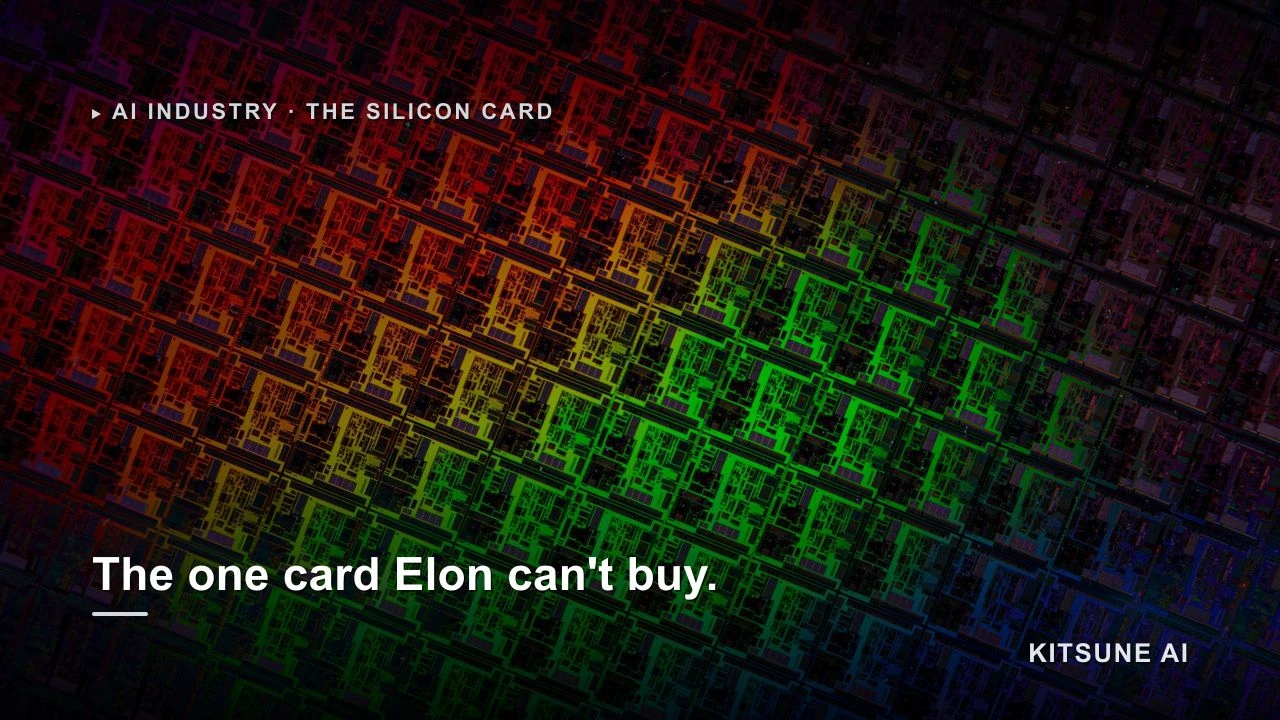
So the missing card cannot be acquired. It has to be manufactured.
And that is exactly the move he made. In March 2026 he announced Terafab, a plan to build a 2-nanometer fab of his own shared across Tesla, SpaceX and xAI, his framing as blunt as it gets: build the fab, or we do not have the chips. The price has already climbed from a reported $25 billion toward $55 billion and a possible $119 billion, and he pulled in Intel as the manufacturing partner, because you do not stand up a leading-edge fab from scratch alone. Tesla's AI5 design taped out around April, fabbed for now at TSMC and Samsung. The shelved Dojo program came back as Dojo 3, the first Tesla supercomputer with no Nvidia in it. There is even a rad-hardened chip line earmarked for the orbital satellites.
Read the pattern. He is building the press that prints the one card he cannot buy.
The prediction worth making
So forget "what does Elon acquire next." That is the easy question, and the wrong one. The real one, the one that is actually a gold mine if you call it early: can he fire Nvidia, and when?
Right now he sits in the strangest position in tech. He is Nvidia's largest customer and the man building the factory designed to never need Nvidia again, at the same time. Every Blackwell rack he installs today is rent on a house he is trying to stop renting. The fifty-million-GPU target and the $55 billion fab are the bridge and the far bank of the same crossing.
I will concede the hard part, because it is enormous. A 2-nanometer fab is the single most difficult object humans manufacture, and even Intel, the partner he brought in to help build it, has stumbled on easier nodes. Terafab is announced, not running. AI5 is samples, not volume, and the real numbers do not land until 2027 and beyond. This could slip for years, and the orbital chips could ride Nvidia longer than the slides suggest.
But the direction is set, and direction is what you bet on.
Watch for the wafer
The headline that matters next is not another acquisition. It is a photograph of the first wafer out of Terafab.
Because the day Grok trains on a chip Elon designed, fabbed, powered with his own electrons and launched on his own rockets, the hand is finally complete. Every card his, every card the same suit, nothing borrowed. The Royal Flush stops being a metaphor.
And the only player who could ever beat it, the one quietly dealing him chips, gets up from the table.